

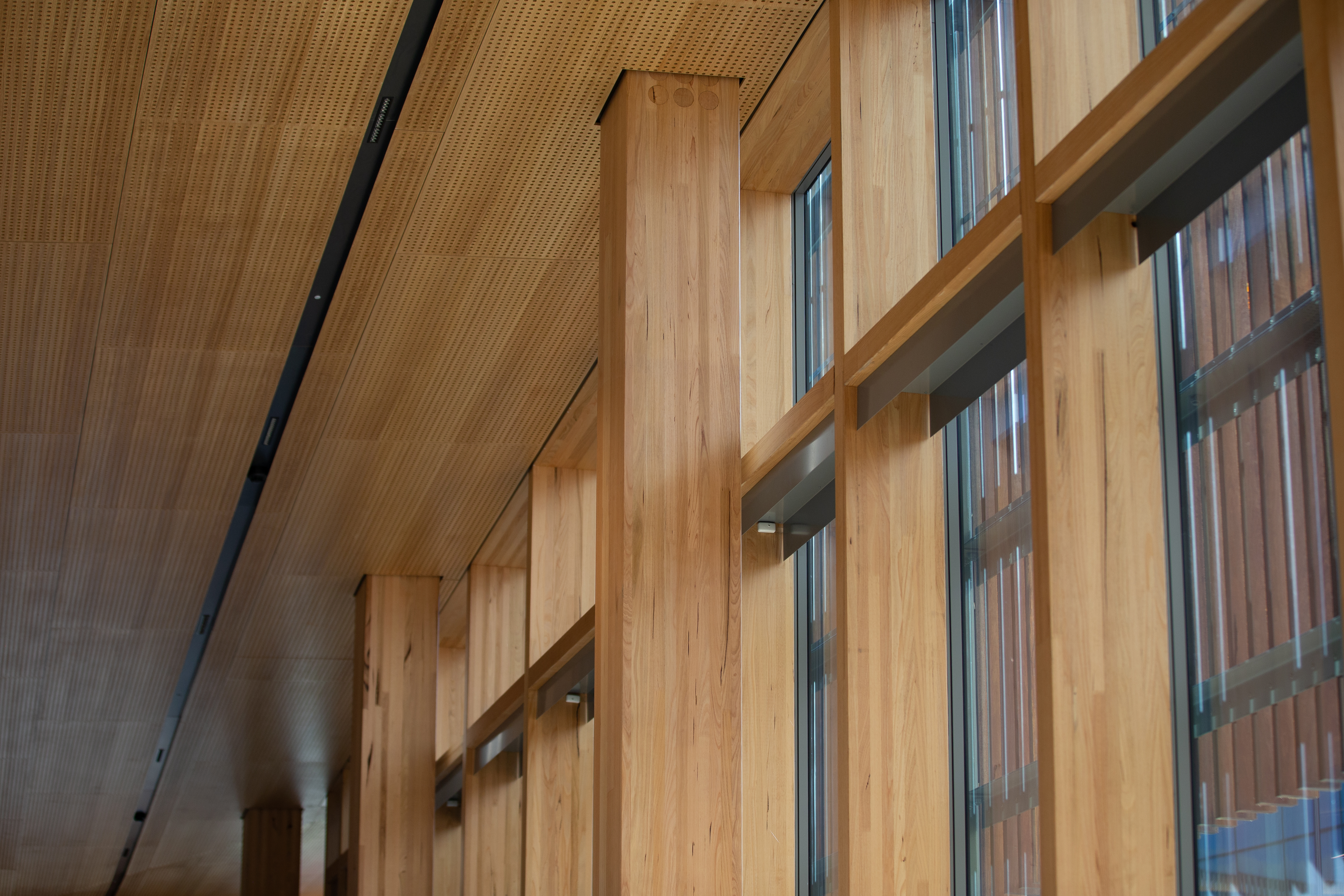
Why choose timber? Building for people, place and the future
Choosing timber is rarely just a technical decision. It’s a statement about what a building stands for: its relationship to the environment, to the people who use it, and to the place it belongs.
Recent research from the Centre for Sustainable Architecture with Wood (CSAW) highlights that the decision to use timber in Tasmanian commercial construction is shaped by a combination of factors, including sustainability, cost, performance, aesthetics and user preference. For clients and architects alike, these considerations are rarely isolated. Instead, they are deeply interconnected, reinforcing one another in the design and delivery of a project.
At the centre of this is a simple but powerful insight: the client sets the agenda.
As research lead Dr Louise Wallis explains, “The client is the most important person in all of this. If they believe in it and they want it, they will make it happen.” That belief can shape everything from material selection to project ambition, often influencing whether timber is considered at all.
This places clients in a uniquely influential position. Rather than responding to industry norms, they have the ability to define them.

A material that aligns with changing priorities
One of the most widely recognised benefits of timber is its environmental performance. The construction industry remains one of the largest contributors to greenhouse gas emissions, and material choices play a significant role in that impact. Timber offers a compelling alternative.
As a leader in climate-focused design – and one of the case studies highlighted in CSAW’s research – the University of Tasmania has embedded sustainability into its buildings across the state. This commitment is reflected in its use of timber as a key material.
As a renewable material, timber doesn’t just reduce reliance on more carbon-intensive materials like steel and concrete – it also stores carbon. As University of Tasmania Vice-Chancellor Rufus Black puts it, “It’s a chance for buildings to be taking carbon out of the atmosphere and locking it up for a considerable amount of time, at the very moment when we need to be doing as much of that as possible.”
Importantly, the research suggests that sustainability is not viewed solely in terms of emissions. Clients and designers are increasingly considering where materials come from, how they are produced, and what they support. Locally sourced timber, in particular, is often associated with lower transport impacts, responsible forest management, and stronger connections to regional economies.

Supporting local industry and identity
In Tasmania, timber carries a strong sense of familiarity and connection. It is widely used in homes, understood by local trades, and supplied by businesses that have often operated within communities for generations.
This creates a clear opportunity for commercial projects to extend that relationship.
Choosing locally sourced timber supports regional employment, strengthens supply chains, and contributes to a sense of self-sufficiency – something that is increasingly important during times of geopolitical volatility. It also reinforces a distinctly Tasmanian identity in the built environment.
For designers, this connection to place is tangible. Alistair Flynn, Associate Principal and project architect at Woods Bagot, who led the design for the University of Tasmania’s Forest Building redevelopment in Hobart, reflects on the role of local timber in shaping that experience:
From a design perspective, the smell, the feel, the colouration, those Australian tones you get from Australian timber, I think, are suitable for buildings in Australia. Mass timber from Europe is also beautiful, but it has a different appearance and feel. I’m biased here, but I think Australian timber is always more appropriate for the Australian context.
These qualities are not just aesthetic; they help ground buildings in their context, making them feel more connected and more meaningful to the people who use them.

Performance and practicality
Environmental and cultural benefits may drive interest in timber, but they only hold weight if the material can actually deliver in practice. Increasingly, the evidence shows that it can.
Advances in mass timber construction and engineered wood products have expanded what is possible in commercial buildings. Research indicates that timber can perform as well as – or better than – traditional materials across a range of criteria, including environmental performance, seismic performance, fire performance, and construction efficiency.
Prefabricated timber elements, for example, can simplify installation and reduce on-site labour, while also supporting precision and quality. In fit-for-purpose applications, timber also offers strong acoustic performance and flexibility in design.
These practical benefits reinforce timber’s viability at scale, supporting its use not just as a values-driven material, but as a high-performing one.

Buildings people respond to
While performance and sustainability are critical, the way people respond to timber buildings is equally compelling.
There is a perception, strongly supported by extensive research, that timber contributes to comfort and wellbeing, aligning with a broader shift toward healthier, more conscious built environments. As Dr Wallis observes, people are naturally drawn to it:
There’s something about timber that you just want to touch… you don’t see people doing that to a concrete wall.
Alastair Flynn agrees. “Before sustainability was even a thing, it was always about warmth and a human touch,” he says. “People love to touch timber, so you put it in places like handrails and balustrades, at eye level, where people can see it. It really brings warmth to a space.”
This response has real implications for how buildings are used. Spaces that feel warm, natural and engaging can support occupancy, attract tenants, and encourage people back into shared environments – something increasingly valued by clients and organisations.
Designing for longevity and reuse
One often-overlooked benefit of timber is the flexibility it offers over a building’s lifetime.
Rather than being fixed and permanent, timber structures can be adaptable and circular. Materials can be reused, reconfigured and, ultimately, returned to the natural environment.
As Rufus Black explains, “we should build buildings for disassembly. They should be designed to be unscrewed, unjointed, unmade, and then re-milled to be used again.” This approach extends the life of materials and reduces waste, while also allowing buildings to respond to changing needs.
Projects like the University of Tasmania’s Forest Building demonstrate how this thinking can be embedded in practice. Timber from the original 1930s building has been salvaged and reused multiple times, including by Robert Morris Nunn in the 1990s, and again in the more recent redevelopment. Alongside this, new timber elements have been designed with future reuse in mind, with components such as partition walls able to be disassembled and reconfigured as the building changes.
This layered approach to material use – where past, present and future are considered together – creates a built-in flexibility that extends well beyond a single project lifecycle. As Rufus Black notes, this means timber can remain in use for a long time before ever needing to return to its natural origins, reinforcing its role as a genuinely sustainable material.

Leading the shift
The growing interest in timber is not happening in isolation. It is being shaped by a combination of client ambition, design leadership and community expectations.
Importantly, these forces reinforce one another.
Buildings that prioritise timber often attract attention, generate positive public response, and help build momentum for future projects. Alastair Flynn believes the current moment offers an opportunity for clients and architects “to be at the front of the wave… and people will follow.”
For clients, this represents a clear opportunity: not just to deliver a building, but to shape what comes next.
Choosing timber is not simply about material selection. It is about aligning a project with broader values, such as environmental responsibility, local identity, and long-term thinking, and in doing so, setting a direction for others to follow.
At a time when the built environment is under increasing pressure to respond to climate and community expectations, that kind of leadership matters.

If you’re an architect, builder, furniture maker or designer looking to make more informed, locally minded material choices which will stand the test of time. You won’t want to miss our upcoming Tasmanian Timber webinar series, providing you with the knowledge to specify timber with confidence.
Register HERE
Subscribe to our monthly newsletter to stay up to date on the series.
Share this Article