

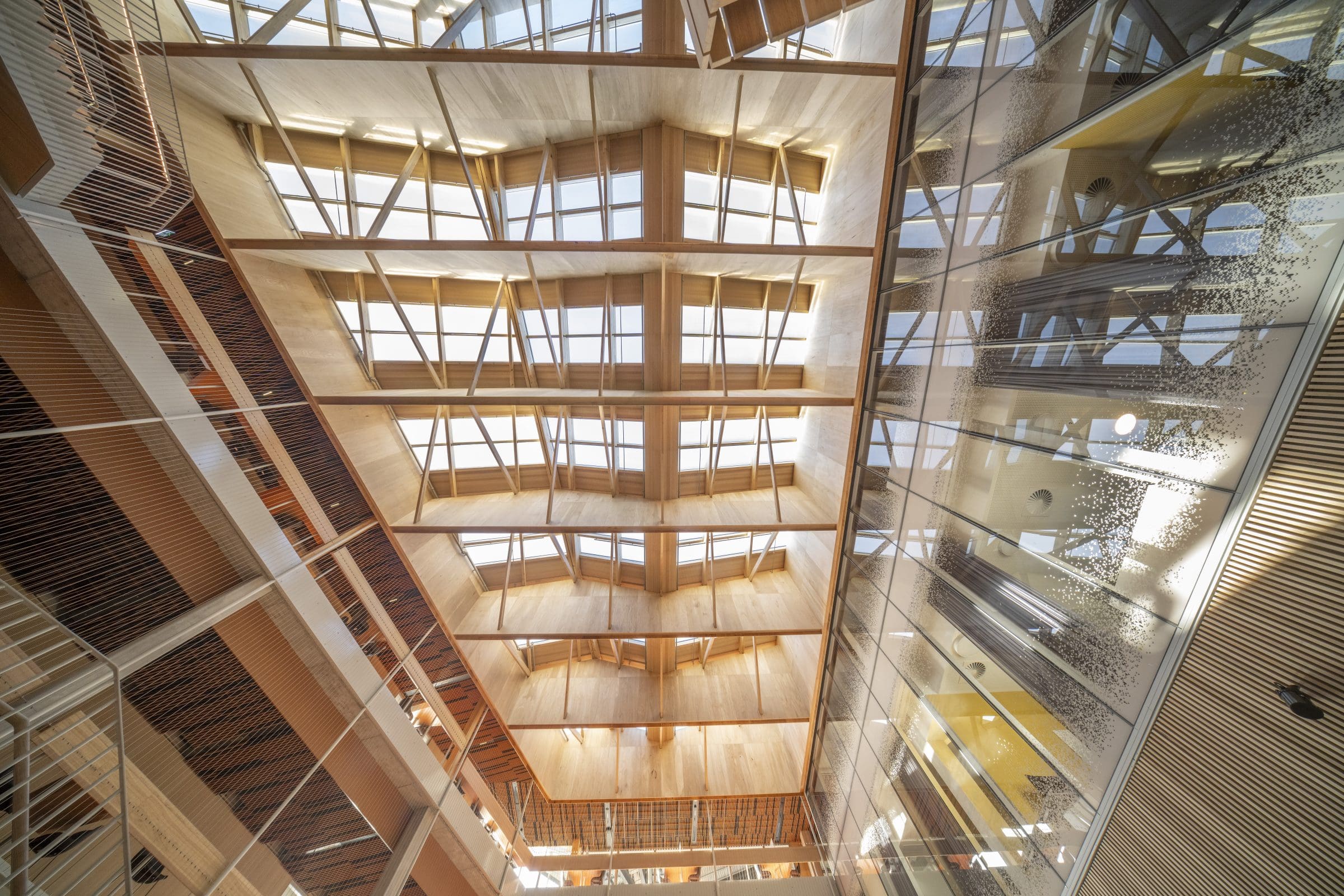
Buildings as a Global Carbon Sink
How timber construction could turn the world’s cities from a climate problem into a climate solution.
Every year the world builds the equivalent of a new city the size of Paris roughly every week. That construction boom is one of climate change’s quiet engines: the concrete and steel that frame our buildings are responsible for a large share of global industrial emissions. But a growing body of research suggests the building sector could become something it has never been before – a place where carbon is stored rather than released.
A landmark study led by Galina Churkina and Hans Joachim Schellnhuber of the Potsdam Institute for Climate Impact Research (PIK) framed the idea most clearly: if the world shifts a meaningful share of new construction to engineered timber, our buildings can act as a global carbon sink, locking away carbon for the lifetime of the structure.[1] Five years on, a new wave of research and a generation of record-breaking timber towers have only strengthened the case.

Trees: nature’s carbon-capture technology
“Trees offer us a technology of unparalleled perfection,” says Schellnhuber, co-author of the study and Director Emeritus of PIK. “They take CO₂ out of our atmosphere and smoothly transform it into oxygen for us to breathe and carbon in their trunks for us to use. There’s no safer way of storing carbon I can think of. Societies have made good use of wood for buildings for many centuries, yet now the challenge of climate stabilisation calls for a very serious upscaling.”[2]
Unlike engineered carbon-capture technologies still being developed and scaled, timber construction delivers benefits immediately. It uses processes that already exist, draws on a resource that regrows, and — crucially — displaces high-emission materials at the same time as it stores carbon. It is one of the few climate levers that works with humanity’s existing need to build, rather than against it.
The problem with conventional construction
The building sector consumes roughly half of all steel produced globally and a substantial share of the world’s cement. Both materials are already highly optimised, leaving little room for further efficiency gains. More fundamentally, a large portion of their emissions is chemically unavoidable: making cement releases CO₂ from limestone regardless of how clean the energy is, and primary steelmaking carries similar process emissions. Even a fully renewable grid cannot take these materials to zero.[3]
The scale of the problem grows with the world’s cities. As population and urbanisation drive decades of new construction, Churkina and colleagues estimated that buildings made from conventional materials between 2020 and 2050 could consume a fifth of the remaining carbon budget for keeping warming below 2°C — emissions locked in by the materials alone, before a single light is switched on.

Modern timber: engineering wood for performance
Mass timber is the umbrella term for engineered wood products — cross-laminated timber (CLT), glue-laminated (glulam) beams and similar – that bond smaller pieces of wood into large, structural components. By engineering out the natural variability of sawn timber, these products give designers a material that behaves predictably and performs at the scale of concrete and steel.
In practical terms, mass timber:
- Delivers predictable, tested mechanical performance suitable for structural use
- Distributes strength strategically across laminated layers
- Achieves fire-resistance ratings that allow tall buildings under modern codes — mass timber chars predictably and retains load-bearing capacity
- Offers structural capability comparable to concrete and steel at a fraction of the weight
Building codes have caught up with the engineering. The 2021 International Building Code introduced three new mass-timber construction types permitting buildings up to 18 storeys.[4] Real projects have gone further still: Milwaukee’s Ascent tower, completed in 2022, rises 25 storeys and is recognised as the world’s tallest mass-timber building — a vivid demonstration that timber high-rises are no longer experimental.[5]

The carbon-storage prize
Churkina’s team modelled four scenarios for the share of new urban buildings using mass timber over three decades (2020–2050):
- Business as usual — around 0.5% timber buildings
- 10% timber adoption
- 50% timber adoption
- 90% timber adoption
In the most ambitious scenario, timber buildings could store between 0.01 and 0.68 gigatonnes of carbon a year, building a cumulative sink of 2 to 20 gigatonnes of carbon over 30 years — enough to increase the carbon already held in urban areas by 25 to 170%.[6]
The density of that storage is striking. A five-storey residential timber building can hold up to 186 kg of carbon per square metre — more than three times the carbon density of the world’s most carbon-rich natural forests (around 52 kg/m²). In effect, a timber city becomes a second forest, one that shelters people instead of standing in the wild.

Lower emissions, not just stored carbon
The climate case rests on two pillars: timber stores carbon, and it avoids emissions. Compared with conventional structures, mass timber buildings have:
- Lower embodied carbon than equivalent steel and concrete structures
- Far lower material intensity — a timber structure can weigh around half as much as a comparable steel-and-concrete one
- Reduced foundation requirements, thanks to that lighter weight
Even in the 90% scenario — where producing all that engineered timber would itself account for the bulk of construction emissions — the overall carbon footprint remains substantially lower than business as usual. The combination of avoided emissions and durable storage is what makes the lever so powerful.

Can the forests supply it?
The obvious objection is supply: where does all the wood come from without stripping the world’s forests? The research points to several routes that, taken together, could meet demand sustainably:
- Redirecting wood currently burned or used for short-lived products into long-lived construction
- Tapping unused harvest potential — around two-thirds of countries analysed could sustainably harvest more timber than they do
- Expanding output from plantation forests, which occupy just 7% of forest area yet already produce 40% of harvested wood
- Using fast-growing alternatives such as bamboo in tropical regions
The authors are emphatic that this only works under careful, sustainable forest management and strong governance. Timber’s climate benefit depends entirely on forests being managed so that what is harvested keeps regrowing — otherwise the sink in the city is simply a deficit in the landscape.

What the latest research adds
Evidence published since the original study has reinforced and extended its conclusions. A 2025 analysis in Nature Communications modelled the global land and carbon consequences of mass timber over a longer horizon, finding that using CLT in 30–60% of new urban buildings between 2020 and 2100 could cut life-cycle greenhouse-gas emissions by 25.6 to 39 gigatonnes of CO₂-equivalent, while increasing long-term carbon storage by some 20–25 GtCO₂e — held mostly in forests and, secondarily, in the timber panels themselves.[7]
Importantly, that work suggests the demand for engineered timber can act as an incentive to expand and better manage forests rather than deplete them — provided the policy and certification frameworks are in place. The newer modelling also underscores that the size of the prize depends heavily on the carbon intensity of timber manufacturing and on end-of-life choices, both areas where the industry continues to improve.
A path forward
For timber construction to reach its climate potential, several things need to happen in parallel:
- Building codes continue to be updated to allow taller, larger timber structures
- The construction workforce is retrained for mass-timber methods
- Manufacturing capacity for engineered timber products expands to meet demand
- End-of-life management prioritises reuse and recycling, keeping carbon locked away longer
- Sustainable forest management is strengthened and certification systems are robustly enforced

Building a safe home on Earth
The transition to timber cities is not a silver bullet, but it is one of the rare climate strategies that is practical, immediate and aligned with what humanity already needs to do — build homes for billions of people. By shifting from mineral-based to bio-based materials, cities can become durable carbon stores while cutting emissions and supporting healthier forests.
Scaled appropriately and paired with reforestation, the material revolution in construction offers a genuine path to balancing the supply of materials, the demand for housing and the imperatives of the climate. As Schellnhuber puts it: “if we engineer the wood into modern building materials and smartly manage harvest and construction, we humans can build ourselves a safe home on Earth.”[8]
Sources:
[1]Churkina, G. et al. (2020). ‘Buildings as a global carbon sink.’ Nature Sustainability 3, 269–276. https://doi.org/10.1038/s41893-019-0462-4
[2]Potsdam Institute for Climate Impact Research (2020). ‘Buildings can become a global CO2 sink if made out of wood instead of cement and steel.’ pik-potsdam.de
[3]Hawkins, W. et al. / recent life-cycle analyses; and Churkina et al. (2020), on the irreducible process emissions of cement and steel.
[4]International Code Council (2021). 2021 International Building Code, Types IV-A/B/C; WoodWorks, ‘Tall Wood Buildings in the 2021 IBC – Up to 18 Stories of Mass Timber.’
[5]Council on Tall Buildings and Urban Habitat; Ascent MKE, Milwaukee (25 storeys, 86.6 m), completed 2022 – world’s tallest mass-timber building.
[7]Mishra, A. et al. (2025). ‘Global land and carbon consequences of mass timber products.’ Nature Communications 16. https://doi.org/10.1038/s41467-025-60245-y
Share this Article