Protecting Tasmania's Giant Trees: How Working Forests Safeguard Our Tallest Trees
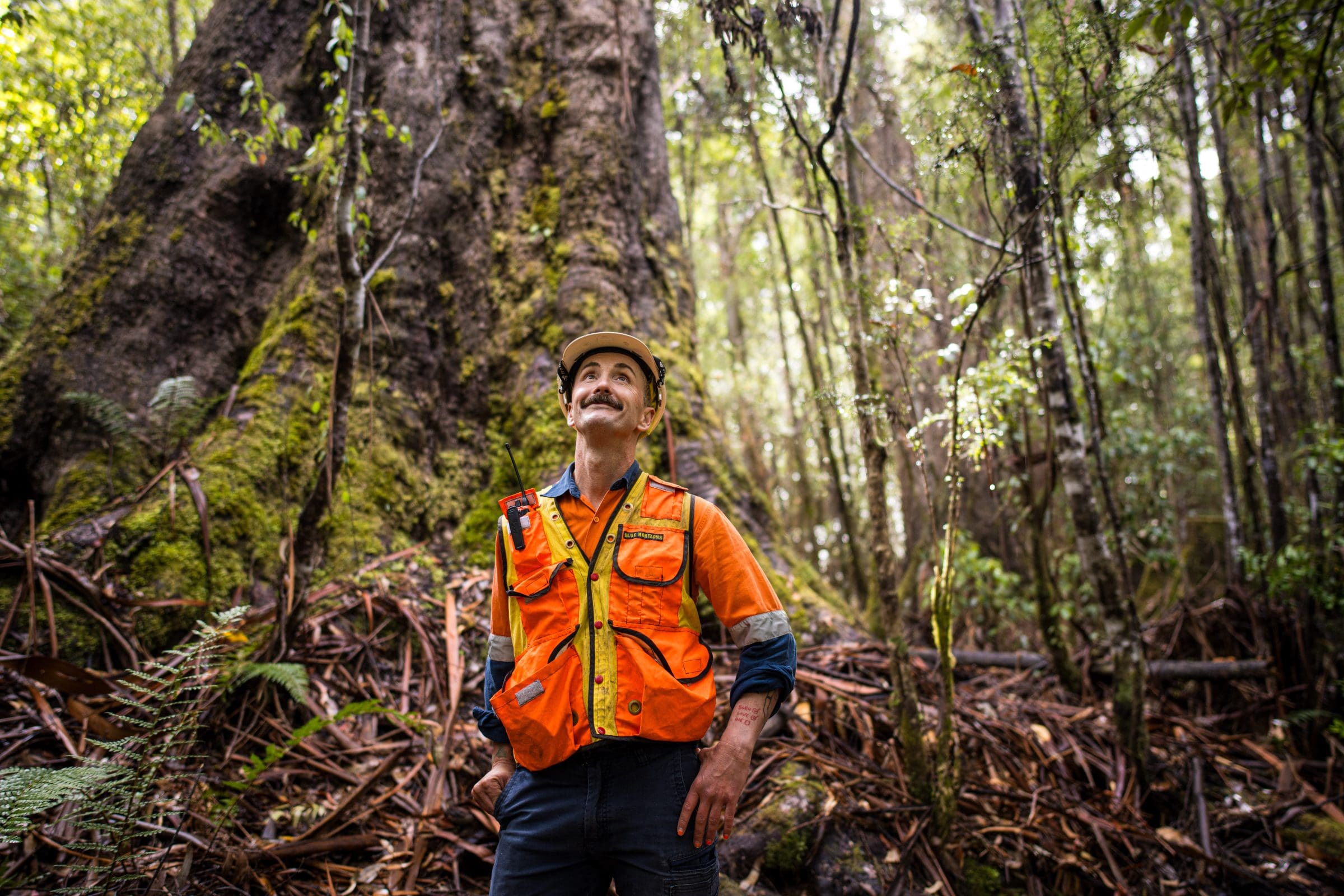
When Daniel Hodge measures a tree, he’s not just collecting data; he’s part of a decades long commitment to protecting some of the largest living organisms on the planet. As Senior Stewardship Advisor at Sustainable Timber Tasmania (STT) and manager of Tasmania’s Giant Tree Program, Daniel oversees the identification and protection of giant trees within the state’s production forests.
It’s a role that surprises many people who assume that working forests and conservation are incompatible. The reality, as Daniel explains, is quite different.
People love big trees, and in Tasmania, we are very special in that we’ve got some of the largest trees in the world. So STT recognised that and has had a policy in place to protect these trees and make sure they stay within the Tasmanian forest. And we’ve had that policy for over 20 years now.

Tasmania’s Unique Natural Heritage
Tasmania is home to some of the tallest trees on Earth. Only a handful of tree species worldwide can reach truly gigantic proportions, the coastal redwoods and giant sequoias of California being the most famous. In Australia, only a couple of eucalypt species naturally achieve these dimensions, and most of them grow in Tasmania.
“There’s only a couple that can naturally get to those really gigantic proportions. So on a global scale, they’re really rare,” Daniel explains. These trees aren’t just impressive to look at.
They’re so big, they’ve got lots of nooks and crannies, and they’re old, so they’ve got hollows and they just contain a whole diversity of different habitats that support a range of species,” Daniel says. “Ecologically they sort of underpin biodiversity in the forest.
A World-Leading Protection Policy
Sustainable Timber Tasmania’s Giant Tree Policy defines a giant tree as one that measures either taller than 85 metres in height or greater than four metres in diameter. Any tree meeting these criteria is identified, protected, and placed into a reserve system, even if it’s in the middle of a planned harvest area.
It’s pretty straightforward,” Daniel says. “These trees will be identified, and they’ll be protected in reserve.
The policy includes a buffer zone around each giant tree, ensuring it’s not just the individual tree that’s protected, but the forest ecosystem around it as well. This provides additional protection and maintains the ecological context that these ancient trees need to thrive.

From 300 Giants to Thousands of Large Trees
Currently, Tasmania has over 300 recorded giant trees on the state register, with 175 of those located in production forests where they’re actively protected. But there are undoubtedly many more throughout Tasmania’s World Heritage areas and national parks.
In 2024, STT took its commitment even further. Working with conservation groups who raised concerns about a forest called “Grove of Giants” in the Huon Valley, and the organisation revised its policy.
They had concerns around a lot of trees, over 150 large, big trees in that coup, most of which wouldn’t have met the definition of a giant tree at that time,” Daniel recalls. “They said, ‘This is a great patch of forest. This is really special. We think your policy could be better.’ We listened to them and agreed and changed the policy.
The policy change has had an unexpected benefit: it’s opened up productive collaboration with citizen scientists and conservation groups. “We have lots of very passionate, concerned citizen scientists, and they actually do an extraordinary job. Spend a lot of time in the bush walking around measuring trees, and then they provide copious amounts of data back to us, which is great.”
This data now feeds directly into operational planning, creating a mutually beneficial relationship between forest managers and conservationists.
Fire Protection: Managing Tasmania’s Most Critical Threat
One of the most crucial aspects of protecting giant trees is managing their relationship with fire, Tasmania’s most significant natural disturbance factor.
For planned regeneration burns following harvest operations, giant and large trees are identified and managed as high-value assets. For bushfires, the trees’ locations are known and registered, allowing them to be managed with the same priority given to plantations, houses, and other high-value assets.
This is where active forest management becomes crucial. The network of roads, the presence of trained firefighting crews, and the detailed knowledge of forest values all contribute to protecting these irreplaceable trees when bushfires threaten.

Working With Nature: The Role of Fire in Healthy Forests
Daniel is passionate about helping people understand something that often surprises non-forest scientists: Tasmania’s eucalypt forests have evolved over millions of years to have a close relationship with fire.
They’re really dynamic disturbance driven ecosystems. If they’re left alone, they don’t stay the same. They’ll always do their own thing. That’s the way they’ve evolved over millions of years. And I think as a society we can either choose to work with that or ignore it and pay the price and the repercussions of that.
The science on fire and forest regeneration is unequivocal. “There’s no two ways about it. The bigger and hotter a fire is, the better the regeneration you get,” Daniel states.
Fire triggers seed dormancy, releases seed capsules, and prepares the soil, all natural benefits that Tasmanian forestry harnesses rather than fighting against. “The question about what it would look like if we took fire out of it? It would look really expensive because we wouldn’t be using those natural systems. We’d have to hand-plant trees like they do in Europe, and it’d probably become much more like a plantation.”
Without fire, the forest composition itself would change. “You’d have a lot of wattle,” Daniel notes, referring to the silver wattle that colonises areas where regeneration burns are unsuccessful or patchy.
The Climate Change Imperative
For Daniel, the connection between sustainable forestry and climate action is clear and backed by global scientific consensus.
Tasmania’s forests represent a real strength and advantage in the climate fight. “We have a real strength here with our forests in Tasmania and a real advantage, and I think we should make the most of that with native forestry.”
The alternative, locking up forests and abandoning active management, would leave them vulnerable to catastrophic bushfires that release massive amounts of carbon while destroying both timber resources and biodiversity values.

Growing Reserves, Not Shrinking Forests
One of the most surprising facts about Tasmania’s production forests is how much of them is actually protected. Of Tasmania’s approximately 1.2 million hectares of old-growth forest, representing a sixth of the state, only 8% is in production forests. And of that small percentage, only half is actually available for harvesting.
So only 4% of old growth is actually in production forest that’s available for harvesting,” Daniel explains. “The rest is already in reserve networks that are growing every day because we find more values, more giant trees, more eagle nests and things like that. So the reserves network just gets bigger and bigger each year.
On top of formal reserves, there are excluded areas, patches with values that may not warrant full reserve status but aren’t compatible with harvesting. These too remain protected within the working forest landscape.
Forest Time vs Political Time
Daniel acknowledges the ongoing tension around native forestry in Tasmania but sees it through the lens of someone who works on century-long time scales.
There always has been and will continue to be a tension between political time cycles and forest time cycles,” he observes. “One of the things I love about working in forestry is that the management and the decisions you make on the ground today, you don’t see the results of that. Your kids see the results of that. It’s in a hundred years you see the results of those actions.
This intergenerational perspective means today’s foresters are “dealing with the legacy of decisions that were made before us, good or bad. We manage forests on very long time cycles. We are modelling for what timber we’re going to have in a hundred years. I don’t think politicians think that far ahead generally.”
World’s Best Practice
Having studied forest management internationally, he completed his Master’s in Forest Management in Sweden, Daniel is confident in Tasmania’s approach.
I haven’t seen better than we have here. It’s touted as world’s best practice.
But he’s quick to add a caveat: “Saying that, I’d hate to think we’d ever rest on our laurels. Just in the short time that I’ve been in the industry, I’ve seen such huge amounts of improvement. It’s been awesome to be part of that improvement, but there’s always more improvement. We can always do better.”

A Message for Specifiers
For architects and designers choosing materials, Daniel’s work demonstrates that sustainable Tasmanian timber comes from a forest management system that doesn’t just harvest trees, it actively protects the largest, oldest, and most ecologically significant specimens while maintaining dynamic, healthy forest ecosystems.
The giant trees dotted throughout Tasmania’s production forests, surrounded by their protective buffers, represent a commitment that goes back more than two decades. The newer large tree protections, informed by collaboration with conservation groups, show a system that continues to evolve and improve.
And the active management framework that makes sustainable timber production possible also provides the infrastructure, knowledge, and capability to protect these irreplaceable giants from bushfire, Tasmania’s most significant natural threat.
We’ve got a real strength here with our forests in Tasmania and a real advantage,” Daniel concludes. “And I think we should make the most of that.
As Daniel himself admits, after more than 15 years in the role, “I’ve never been bored a day.” When asked what he loves most about his work, his answer is simple: “Easy. Being out bush.”
Listen to Daniel Hodge’s Original Thinkers Podcast episode: Protecting Tasmania’s Giant Trees HERE
Share this Article