

Building with timber: understanding the financial equation
Cost is often the first – and sometimes the final – consideration in construction decisions. In Tasmania’s commercial sector, it is often identified as a key factor influencing whether timber is used in a project.
There is a widespread perception that building with timber, particularly mass timber construction (MTC), is more expensive than conventional materials like concrete and steel. The research suggests this perception isn’t unfounded – but it is incomplete.
In reality, the financial implications of choosing timber are nuanced. While upfront costs can be higher in some cases, a broader view of value – one that considers time, returns, and long-term performance – can shift the equation significantly.

Looking beyond upfront cost
Several factors can contribute to higher initial costs for timber projects, particularly in Tasmania. Local manufacturing remains at a relatively small scale, with limited vertical integration across the supply chain. As a result, in-state engineered wood products can be more expensive than imported alternatives, which benefit from larger, more automated production systems.
There are also project-specific considerations. Appearance-grade timber may require specialist trades for installation or finishing, and in some cases, expertise must be brought in from interstate to support construction. These factors can add to upfront costs, particularly in a market where local experience is still developing.
Dr Louise Wallis was the lead researcher on a recent project that explored opportunities and barriers for the use of timber in Tasmania. “At the moment, there can be a greater cost in using timber,” she says. “But it really depends on how repeatable components are in a building, and the expertise of the design and engineering team. If they have experience, they can often get those costs down.”
This highlights a recurring theme in the research: cost is not fixed. It is influenced by design decisions, capability, and the level of coordination across the project team.

Time as a financial lever
One of the most consistent benefits identified in both the literature and stakeholder interviews is speed of construction.
Mass timber aligns with a broader shift in the construction sector towards prefabrication and product-based delivery. Components are manufactured off-site and assembled on-site, reducing the need for large construction crews and enabling more efficient installation.
Insights from completed Tasmanian projects reinforce this. Martin Rees, a board member with Tasmanian health insurer St Lukes, describes how construction timelines on the company’s building in Launceston improved dramatically as teams became more familiar with the system.
By the time we got efficient here, every 10 days, we’d put up another floor. That would take you 30 to 40 days for a concrete and steel building.
The financial implications of this are straightforward. Faster construction means buildings can be completed and occupied sooner – bringing forward rental income and reducing holding costs. As Martin states, “time saved in the program brings the building earlier to the market, so there’s an economic benefit in that.”
Research findings support this experience, pointing to reduced on-site labour requirements and the efficiencies of prefabricated systems as key contributors to cost savings.

Creating value through design and performance
Beyond construction efficiencies, timber buildings can also generate value in less direct, but increasingly important, ways.
One of these is tenant demand. As sustainability and carbon reporting become more central to corporate decision-making, the environmental performance of buildings is beginning to influence leasing behaviour.
Dr Louise Wallis explains that for large companies, particularly those listed on the ASX 200, “leasing or owning buildings which emit less carbon makes for a better balance sheet.” This is already translating into market behaviour.
We’ve got tenants in here that are paying a premium per square metre compared to an alternative building, because it’s timber,” says Martin Rees. “They are mostly global and national public companies who have ESG responsibilities and therefore they are prepared to pay a premium.
Higher rents, in turn, can increase the overall value of the building, shifting the financial outcome beyond the initial construction cost.
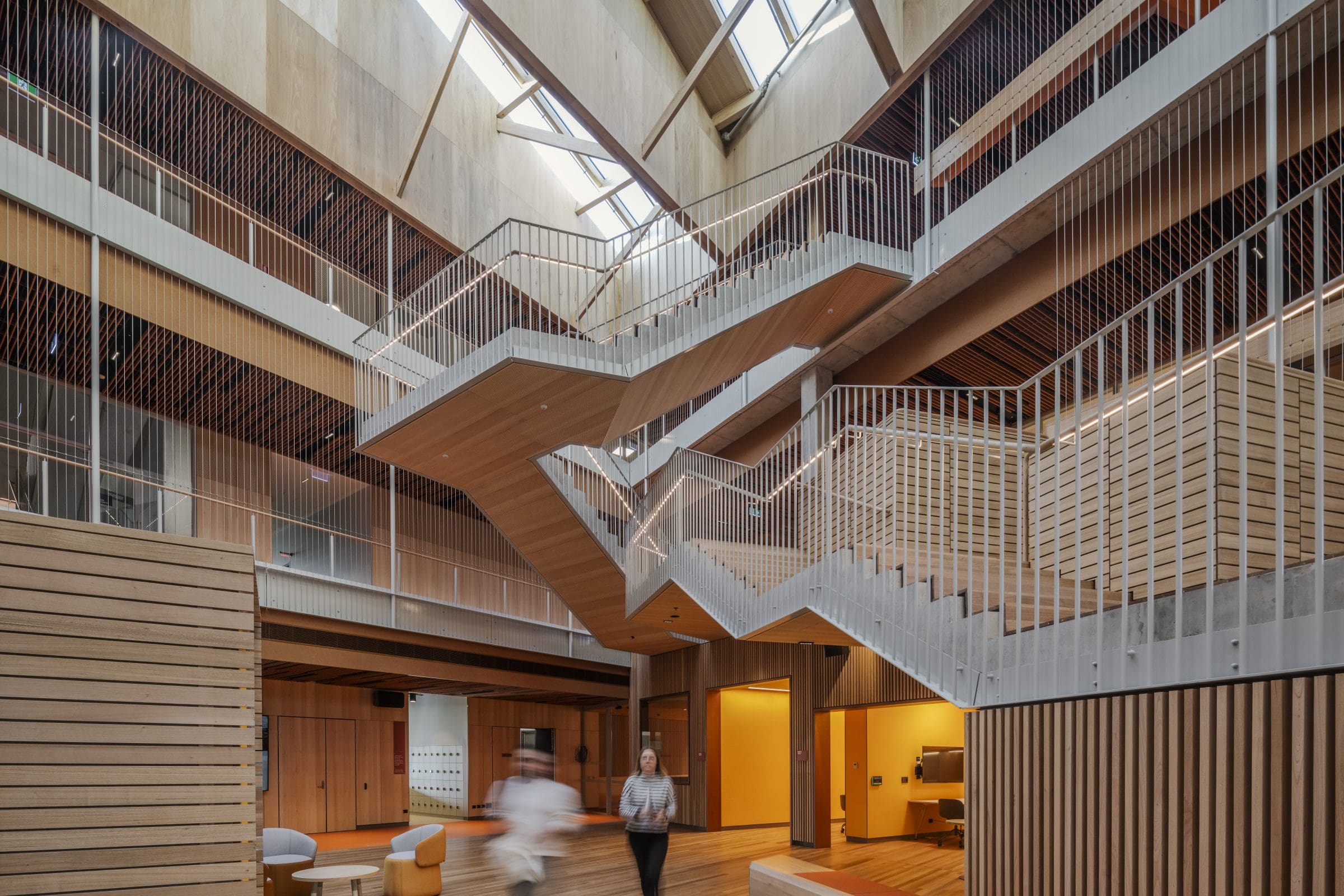
Timber can also reduce costs at the fit-out stage. Exposed structural elements often double as finished surfaces, reducing the need for additional materials and treatments.
Your actual fit-out costs are lower because you use the timber as your feature pieces,” explains Martin Rees. “You don’t put in a ceiling. You don’t need as much sound insulation. Your fit-out costs go down, and that’s another benefit to a tenant.
These kinds of savings are not always captured in early cost comparisons, but they contribute to the overall financial performance of the building.

An evolving cost landscape
While the evidence points to clear opportunities, the research also emphasises that cost outcomes are still variable. Mass timber remains a relatively new approach in the Australian context, and there are limited real-world examples with fully comparable data.
However, emerging studies are beginning to quantify the potential. One recent analysis of a mid-rise building in Melbourne found a 6% cost saving for mass timber construction compared to concrete: equivalent to approximately $500,000.
More broadly, research suggests that timber can perform as well as, or better than, conventional materials across a range of criteria, including cost – particularly as experience grows and systems become more standardised.
In Tasmania, there are additional dynamics at play. Local products can carry a price premium due to smaller-scale production and supply chain fragmentation. At the same time, there is strong interest from some clients in using locally sourced timber, even at a higher cost, reflecting the value placed on provenance and sustainability.

A more complete picture of value
Ultimately, the research suggests that framing timber as simply “more expensive” misses the bigger picture.
Yes, there can be higher upfront costs – particularly in emerging markets or less experienced teams. But these need to be weighed against potential savings in construction time, reductions in fit-out costs, and the growing market value associated with low-carbon, high-quality spaces.
As understanding of mass timber grows, and as supply chains and skills continue to develop, the financial case is likely to become clearer.
For now, the key takeaway is not that timber is always cheaper, but that it can be financially competitive in ways that are not always immediately visible. When assessed across the full lifecycle of a project, timber is not just a material choice, it is a different way of delivering value.
Share this Article