

Building for wellbeing: how timber shapes the way we feel
In many construction projects, the argument for timber is often framed in terms of carbon, cost or constructability. But another factor is becoming just as influential: how buildings make people feel.
Research from the Centre for Sustainable Architecture with Wood (CSAW) shows that in Tasmania’s commercial construction sector, wellbeing is not a secondary benefit of timber – it’s often central to the decision to use it.
Clients, architects and project teams consistently pointed to a combination of factors: sustainability, aesthetics and user experience. But these weren’t seen as standalone drivers. Instead, they worked together, with timber’s contribution to comfort and wellbeing reinforcing its environmental credentials.
At the heart of this is a concept known as biophilia: the idea that people have an innate affinity with the natural world, and that built environments can support health and wellbeing by reflecting that connection.

Why natural materials matter
A growing body of research links timber-rich environments with reduced stress, improved mood and increased comfort. Studies have also found associations with lower heart rates, better concentration and higher productivity. While the evidence base is still evolving, the direction is consistent: natural materials can help create spaces where people feel calmer, more focused and more at ease.
What’s notable in the Tasmanian context is how closely this aligns with lived experience. Across the CSAW case studies, clients and project teams didn’t describe wellbeing as an abstract concept; instead, they described how people respond to timber in real buildings. Users prefer it. They feel more comfortable in it. And increasingly, those responses are shaping design decisions from the outset.

At St Lukes Launceston headquarters, the connection between material and wellbeing was not incidental – it was a key part of their initial brief. As Board Member Martin Rees explains, the organisation set out to create a building that reflected its broader ambitions around improved health.
We wanted this building to reflect our culture of being healthy and our desire to have the healthiest island on the planet.
In response, timber emerged as a defining element of the design.
Two of the architects who responded came back with timber as the core concept in the healthy design, from the view of healthy internally for our staff, healthy in terms of the carbon sink for the community, and healthy in driving people’s view on what should be built.
That framing is telling. Timber wasn’t just selected for its environmental performance, but for its role in shaping a healthier indoor environment and, more broadly, influencing expectations about what good buildings should offer.
Since moving into the completed building, those intentions have translated into tangible outcomes. Rees points to reduced staff turnover and fewer sick days, alongside consistently strong feedback from staff about the space itself.
Fundamentally, they love the environment. They’ve got the timber, they’ve got the light, and there’s plenty of space. Staff, in numerous surveys, say they absolutely love working in here.

Designing for learning, focus and connection
A similar emphasis on experience can be seen at the University of Tasmania, where timber has been used extensively across new developments to support both learning outcomes and student wellbeing.
For Poppy Fay, Director of Campus Futures, timber plays a dual role supporting sustainability goals while also shaping how spaces feel and function.
There’s a feeling that timber brings to buildings,” she says. “A sense of warmth. It’s tactile, and when you walk through the space, it really brings a sense of calm.
In educational settings, that tranquillity is not just desirable, it’s functional. Research into learning environments increasingly points to the importance of reducing stress and supporting focus, and UTAS projects have consciously responded to that.
There’s a lot of new research around natural materials like timber really positively influencing people to have lower levels of stress and higher levels of focus,” continues Fay. “Those things are really important in a learning environment.

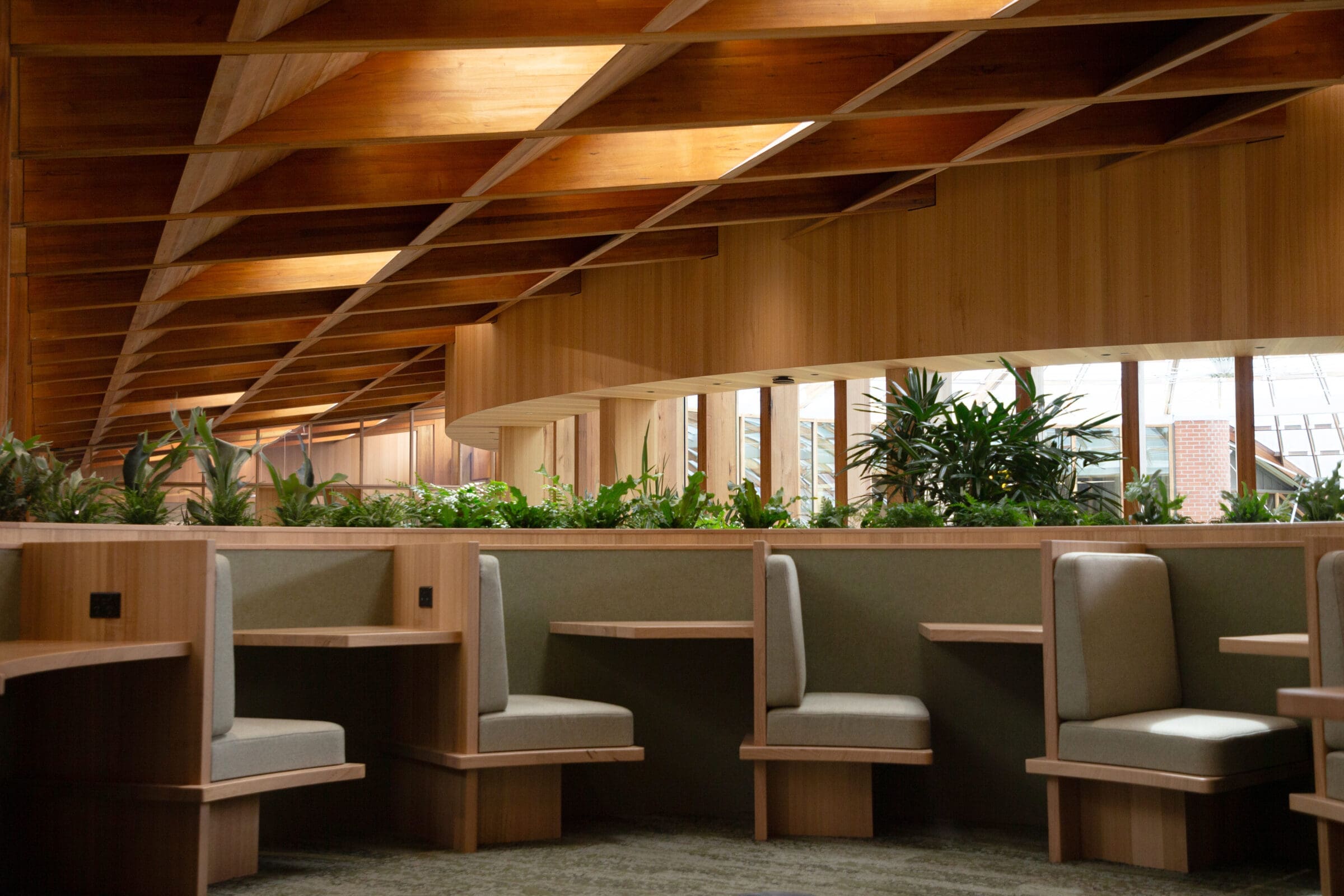
Achieving that outcome is not straightforward, particularly in large, complex buildings like The Forest in Hobart. Fay describes how timber is combined with natural light, greenery and carefully planned sightlines to maintain a connection to nature throughout the space.
It’s all really aimed at making students feel comfortable, safe, and welcome, generating low levels of stress and that ability to concentrate.

For UTAS Vice-Chancellor Rufus Black, the impact of timber goes even further, shaping how people perceive and relate to institutional spaces.
People love timber,” he says. “There are several studies that show if you put a high enough percent of timber in a building, you get the same kind of biological responses as if you walk in a forest. It’s the natural world, but presented to you in a human-made form.
That response has important implications for how buildings are experienced.
It feels less institutional, it feels calmer, it feels friendly, it feels inviting,” says Black. “It’s a way of making spaces feel like they’re for everyone.
Building for a more human-focused future
Taken together, these examples point to a broader shift in how buildings are being valued. Alongside cost, compliance and carbon, there is growing recognition that material choices also shape human outcomes – how people feel, behave and connect within a space.
That shift is happening at a time when the role of shared spaces is changing. As work and study become more flexible and often more isolated, the environments people return to need to offer something more: a sense of connection and comfort.
In that context, timber’s role is not simply technical or aesthetic. It is experiential.

It offers a way to bring aspects of the natural world into everyday environments, supporting focus and a sense of belonging. It connects buildings to place, particularly when sourced locally. And it aligns with a wider move towards creating spaces that prioritise health and wellbeing alongside performance.
For a sector increasingly focused on what makes a building successful, that matters.
Because ultimately, the value of a building is not just in how it performs, but in how it is experienced – and in the role it plays in supporting the people who use it every day.
Share this Article