

The century test
Timber gets cut from a fitout on budget. What goes in instead can never be worth anything again – and the interior is rebuilt eight or nine times over the life of a building.
We spent an afternoon this week with Chris Simpson, a furniture restorer who has given his working life to giving old furniture a second one. We went in expecting a story about craft. We came out with a question about office fitout.
Chris works on pieces older than most of the buildings we work in. He takes furniture that has been discarded, water-marked, painted over and written off, and returns it to service – not as an ornament for a corner, but as furniture somebody uses every day.
Ask him how it is possible and the answer turns out not to be about his skill at all. It is about decisions somebody else made a century ago.
If you’re making something to last, you’re better off gluing it with animal glue… if a joint gets a bit loose, you just heat it up and it reactivates the glue – you can clean off the old glue and reglue it, so it just keeps going.
Solid sections. Joinery, and a glue that lets go. A finish that can be stripped and redone. None of it was done with the future in mind – it was simply how furniture was made. But the effect is that the material is still there, still workable and still worth something, four or five owners later.
Chris is not in the fitout business, but what he was describing was a set of conditions under which a made thing survives being used – and those conditions are settled, or lost, every time an interior is drawn.

The century test
Three things decide whether anything made can be brought back: what it is made of, how it is held together, and how it is finished. In a commercial interior all three are settled in a finishes schedule.
The material is not a close contest. Solid timber is the same material the whole way through. Cut into it, plane it back, re-machine an edge, and it is still timber – which is why a cabinet can lose a few millimetres and gain another fifty years. That is a property of solid timber, not of old timber: a new Tasmanian oak benchtop has it, and MDF does not.
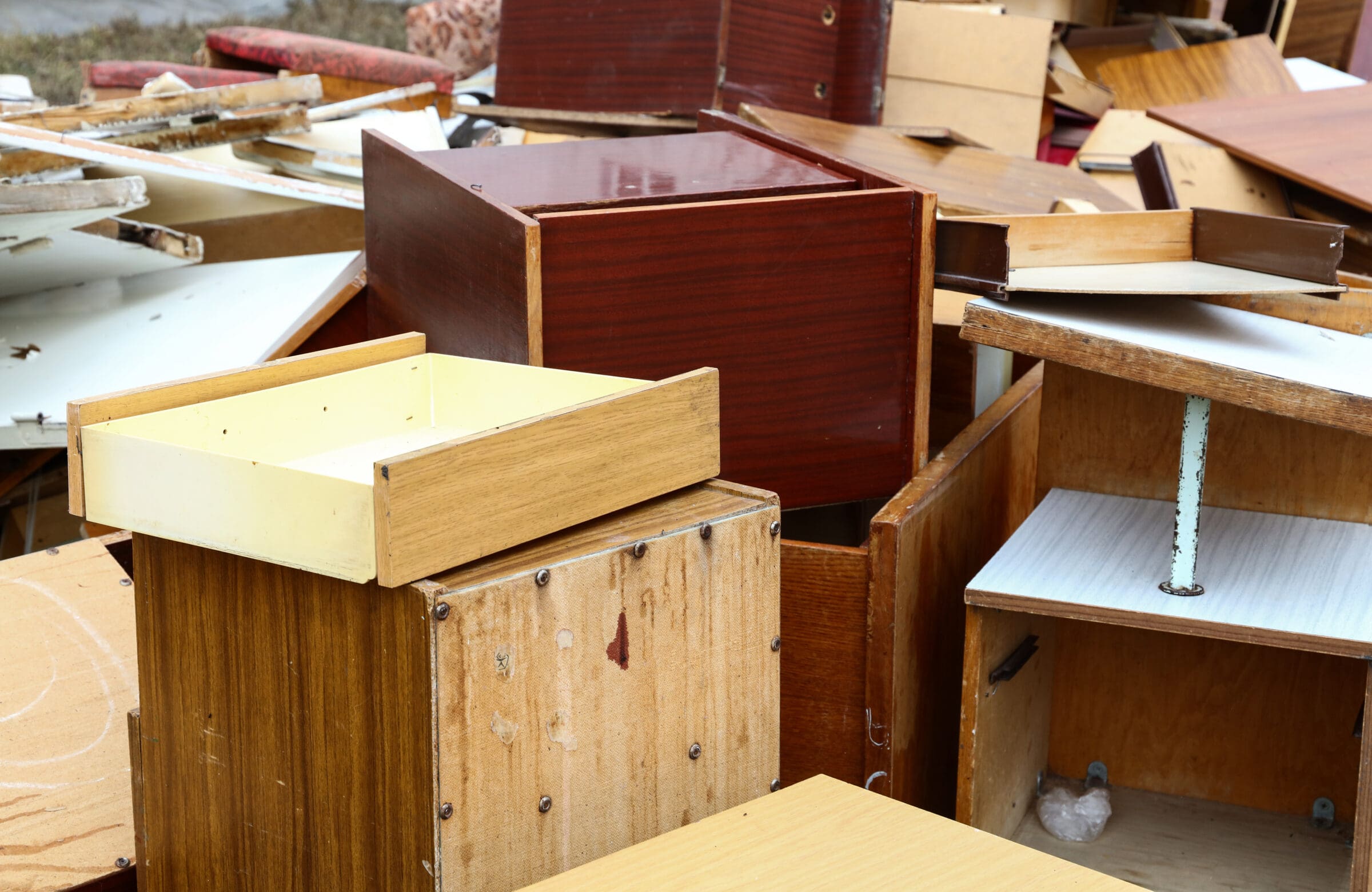
We’re getting a lot of inquiries where people have dropped water on it, it’s expanded, and once it expands you can’t do much about it – it ends up in landfill.
Timber takes water and can be dried, sanded and repaired where it stands. MDF takes water and is finished. This is a comparison with MDF, not with veneer – a real timber veneer takes a single log a great deal further, it is a high-value finish, and it is not what gets torn out and skipped.
Connection is the second test, and modern structural adhesives fail it: “If you use something like epoxy, when it eventually breaks, it won’t break at the glue joint – it’ll break somewhere else in the timber.” The third is the finish. A modern lacquer, Chris says, is “like putting a layer of plastic over the timber so it can’t breathe”, where a traditional polish flexes and a scratch can be worked out by hand.
Put the century test to your last fitout. Could anyone, in a hundred years, do anything at all with what you installed? For most commercial interiors the answer is no – and it is rarely recognised as a design decision, because nobody makes it out loud.
Timber is not rejected. It is substituted.
There is a moment near the end of most commercial projects that never appears in the photographs. The budget is over, the programme is tight, and someone goes through the finishes schedule looking for savings. The timber is still on the drawings. It is just no longer timber.
Research by the Centre for Sustainable Architecture with Wood, commissioned by the Tasmanian Forestry Hub, gives this a name: timber-like substitution, where a specified timber becomes a product that merely looks like timber, arising from value management at the end of a project. The interior is where a stretched budget goes looking first – not the structure, locked in early, but the fitout, where the change is late, quiet and framed as like-for-like.
What the substitute really costs
It is not a like-for-like swap. Around half of timber’s dry weight is carbon it took out of the atmosphere and now holds in the building. What replaces it is defined by its adhesive – and adhesive is where the carbon sits. Arup’s guidance for the Institution of Structural Engineers puts sawn timber at roughly 0.07 kgCO2e per kilogram; the resin that binds engineered board is around 1.5, more than twenty times the carbon intensity of the timber it holds together.
Then the value equation turns. The saving is real on the day it is made. What it buys is a material that can only ever be disposed of. Solid timber holds value after installation – repaired, refinished, moved, resold, or simply left for the next tenant to keep. Adhesive-bonded board has no second-hand market and no salvage value, and never will. Its worth on the day it is removed is less than nothing, because somebody has to pay to take it away.
So the substitution does not swap an expensive finish for a cheaper one. It swaps an asset for a liability, and books the difference as a saving. Taryn Cornell of the Green Building Council of Australia puts that liability at around $105 per square metre of material ordered, installed, and then sent to landfill.

And then it happens again
A building’s structure is installed once. We have written before about what that looks like done well – Save the Children’s headquarters in Norway, designed from the outset to come apart and be reused. Getting a building to that standard is hard-won work, and the architects and clients who do it carry real risk to get there.
The interior is different. A commercial fitout lasts five to seven years. Over the life of a building it is installed, demolished and replaced eight or nine times. Analysis by RESET sets out what that repetition does: on a typical 8.5-year refit cycle, a building’s interiors generate around 32 per cent more embodied carbon over 50 years than its core and shell, and where leases run short they approach four times it.
Over the life of a building, the fitouts can out-emit the building.
A substitution made at value management is therefore not made once. It is made again at the next refit, and the one after that, for as long as the building stands.

A third of the skip is furniture
More than 400,000 square metres of office space is refitted every year in the Sydney CBD. Work by Edge Environment for the Better Buildings Partnership puts the strip-out at 63 kilograms per square metre – roughly 25,000 tonnes a year – of which just 21 per cent is diverted from landfill, against the Partnership’s own 80 per cent target.
A third of that is furniture and joinery, and it is the fraction with nowhere to go. Adhesive-bonded board has no established recovery route, which is why the Partnership has had to go to UNSW’s SMaRT Centre to develop one from scratch. Solid timber, by contrast, arrives at the end of a fitout as material somebody else can use. And disposal only gets dearer: the NSW metropolitan waste levy has more than tripled in seventeen years, to $180.20 a tonne.
Even the best strip-out could not save the board
Australia’s best-documented strip-out makes the point better than any argument can. When eight floors of Governor Macquarie Tower were stripped as a trial, the project recovered 61 per cent of 891 tonnes against an industry standard of about 20 per cent, and did it at no additional cost. The metals went to scrap merchants, the plasterboard to a gypsum recycler, the hard fill to a concrete recycler, the glass into insulation manufacture, and the usable furniture to charitable redistribution.
The composite timber had nowhere to go. The case study lists it among the streams for which no recycling solution existed – a gap the industry is still working on. A deliberate, well-resourced, best-practice strip-out recovered the metal and still sent the board to landfill. That is the ceiling on what good intentions can achieve once the specification has been made.
What the workshop tells us to specify
None of this reaches us as fitout advice; Chris restores furniture. But translate what he does into a specification and it reads as a short and unremarkable list – for an office, a commercial interior, or a house:
- Connect it, don’t bond it. Mechanical and reversible fixings wherever the detail allows. A permanent adhesive is a decision to send the whole assembly to landfill.
- Choose natural finishes. Oils, waxes and polishes renew in place. A sealed coating cannot – once it fails, the surface under it fails with it.
- Use solid material where hands land. Benchtops, fronts, edges, rails – the surfaces that wear are the ones worth being able to renew.
- Prefer loose to built-in. Joinery fixed to a substrate dies with the lease. Freestanding pieces move on.
- Protect it in the schedule. If timber is the first thing value management reaches for, the saving needs to be found somewhere that does not cost the interior its second life.
None of it means solid timber everywhere; a carcass inside a wall does not need to be beautiful. The argument is for durable material where the churn actually bites – and the resource is well up to it. Chris, on Tasmanian oak: “It’s a very good timber that’ll keep going for a long time.”
Who owns the second life
There is a structural reason none of this happens by default, and it has nothing to do with materials. The tenant pays for the interior, uses it for six years, then pays again to destroy it. The landlord owns the shell but not the joinery. The next tenant starts from zero. Even where the material could have a second life, nobody on the lease has a reason to collect it. Chris, who makes his living inside the second-hand market, describes the alternative without needing a term for it:
You do up the office with all this beautiful furniture and timber, and when you leave, instead of throwing it all away, you can sell it off, send it to auction, or the people taking over the office might love it so much they keep a lot of it.
That is an ownership problem with ordinary commercial fixes: make-good clauses that reward retention rather than mandate demolition, landlord-owned base joinery refinished between tenancies, interiors leased rather than bought.
The case for timber in a building is argued early, by people prepared to carry the risk, and once won it stays won. The case in the interior is conceded late, on cost, to a product that looks the same in a render – and then conceded again at the next refit, and the one after that.
Chris Simpson can save almost anything that was built to be saved. The question his workshop puts to the rest of us is whether we are still making anything that qualifies.
Share this Article