

The greenest way to build is the one we keep trying to do without
Sustainable Tasmanian timber is climate action, sovereign supply and good science. We should value it the way we value our wine and our wool.
By Marita Pierce-Indugula, Chair, Tasmanian Timber Promotion Board.

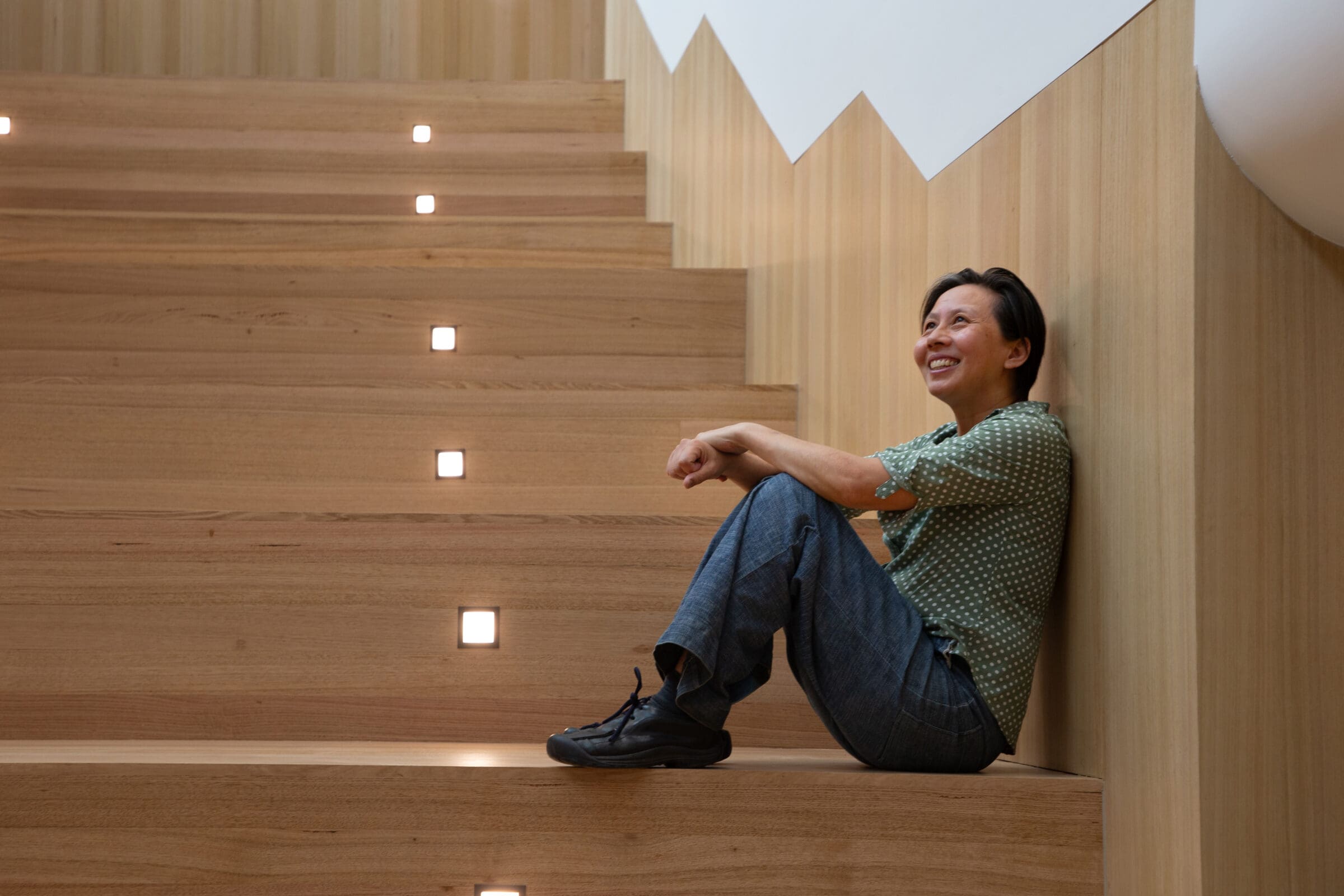
Walk into the University of Tasmania’s new Forest campus, or any building made with real timber, and the first thing you notice isn’t the carbon arithmetic. It’s how the place feels – warm, calm, human. People reach out to run a hand along the handrails. Architects now talk about “neuro-architecture”: natural materials like wood measurably lower our stress and lift our focus. But behind that feeling sits a serious climate and economic story that Australia keeps overlooking.
Buildings and construction account for roughly 40 per cent of the world’s carbon emissions, much of it locked up in concrete and steel – among the most emissions-intensive materials we make. Timber is the opposite. A tree draws carbon out of the atmosphere, and a timber building keeps storing it for as long as the building stands. The UTAS Forestry Building cut its embodied carbon by about 44 per cent against a conventional design, simply by building in mass timber. That isn’t a future technology. It’s carbon we can avoid today.

This isn’t a fringe idea. Hans Joachim Schellnhuber, founding director of the Potsdam Institute for Climate Impact Research, calls trees “a technology of unparalleled perfection” and says there is “no safer way of storing carbon” – if we engineer the wood into modern building materials and smartly manage harvest and construction, in his words, “we humans can build ourselves a safe home on Earth.” The Intergovernmental Panel on Climate Change reached much the same conclusion: a forest managed for a sustained yield of timber while maintaining or increasing its carbon stocks delivers, it found, “the largest sustained mitigation benefit.”
And yet Australia imports around $7 billion of timber and wood products every year – far more than we export – much of it from countries with weaker environmental rules than our own. In a world of new tariffs, rising freight costs and trade uncertainty, leaning ever harder on imported timber is a strange bet, especially when it flows straight into the cost of building a home. “Australian timber for Australian homes” isn’t a slogan. It’s basic economic sense, and basic climate sense.

There’s an uncomfortable logic we rarely confront. Demand for timber isn’t going away. If we don’t grow and harvest it here, under some of the most rigorous rules in the world, we simply import it – and export the environmental impact onto someone else’s forest. As Dr Marie Yee, a conservation scientist with Sustainable Timber Tasmania, has put it: if you care about biodiversity and about the planet, why would you choose timber logged to a weaker standard overseas over timber grown sustainably at home?
Yee’s own story is worth hearing. She came to Tasmania as a forestry critic, certain her research would prove the industry was wrecking biodiversity. It didn’t. Her PhD found that the species richness of forests regrown after the harvesting of the 1960s and ’70s was broadly on par with old growth – because biodiversity depends on a patchwork of forest ages, which careful landscape-scale planning, retention and reserve corridors are designed to maintain. That is not an argument for complacency. Tasmania has threatened species – the swift parrot among them – that need active, science-led protection, and they get it: habitat mapping, pre-harvest acoustic monitoring and surveys, and important areas kept out of harvest altogether. Good forestry isn’t the absence of harvesting. It’s harvesting done with exactly that kind of care.

And the scale is smaller than the rhetoric suggests. More than 80 per cent of Tasmania’s old-growth forest is permanently protected in reserves; only a small share is ever available to harvest. Harvest volume is set by long-term sustainable-yield science rather than by market demand, and it has been declining, not expanding. Whatever is harvested is regrown. Large and giant trees are excluded from harvesting.
There’s a further point we forget. A managed forest is a forest with roads, crews and the capacity to fight fire – and catastrophic bushfire, not the chainsaw, is now the gravest threat to Tasmania’s wildlife and its forests alike. Walk away from active management and you don’t get a museum. You get a tinderbox.

None of this should be controversial. Tasmania sends its wine and beef to the mainland, its cherries and dairy overseas, its wool to the world – around $6 billion of goods a year. Nobody calls that a scandal. It’s how a small island with extraordinary natural resources earns its place. Timber is no different: a renewable, independently certified, carbon-storing product that the rest of the country needs and that we can supply responsibly.
The climate conversation is full of genuinely hard trade-offs. This one isn’t. A sustainably managed forest gives us a material that stores carbon, builds healthier places to live and work, strengthens the economy, reduces our dependence on imports, and helps guard the bush against fire. The question was never whether we can afford to keep doing it, and doing it well. It’s whether we can afford not to.
Share this Article