


Building a Healthier Future: How St. Luke’s Brought Timber to the Heart of Launceston
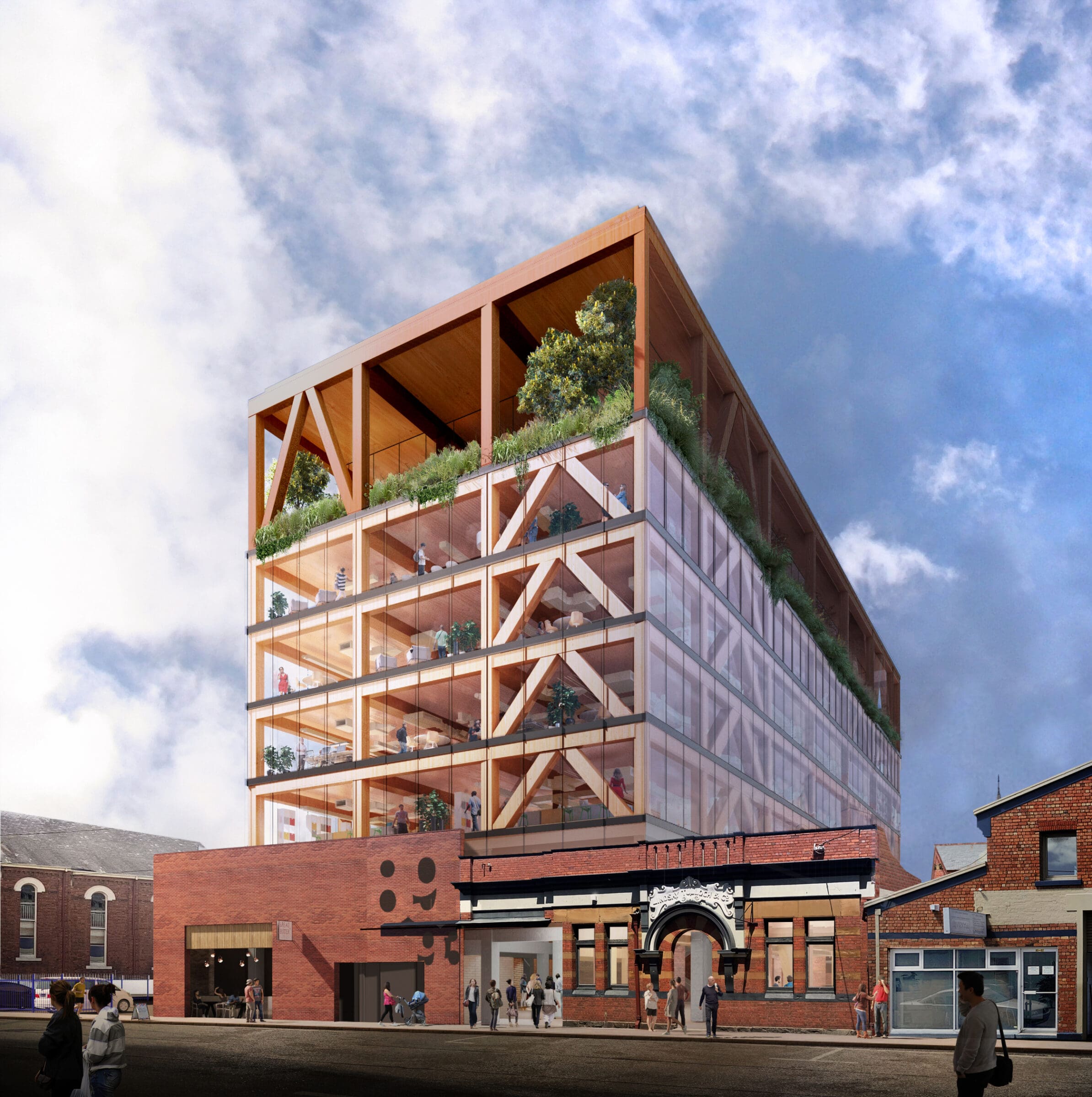
When St Lukes Health set out to consolidate four ageing Launceston offices into one headquarters, they did not simply want a building. St. Luke’s bold ambition was to make Tasmania the healthiest island on the planet by 2050. The result is a seven and a half thousand square metre mass timber office, the largest mass timber building in Tasmania and arguably the most sustainable build undertaken so far.
From Tasmanian plantation hardwood CLT floors and ceilings on the St. Luke’s corporate levels to decorative Tas Oak and minor species used extensively throughout the build, St. Lukes has demonstrated why Tasmanian timber belongs at the heart of it.
A Vision Built in Health
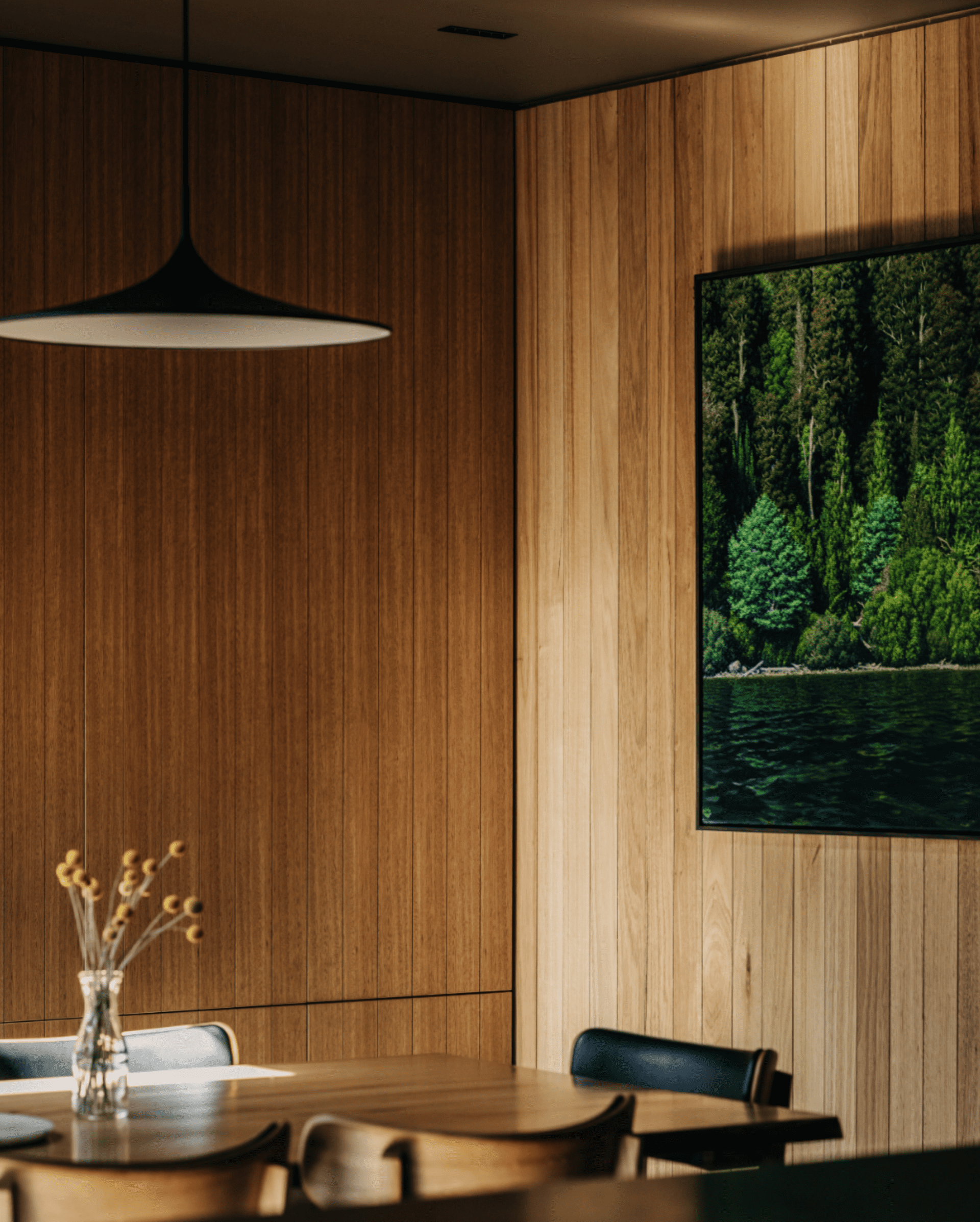
St. Luke’s Health had a clear vision for their new headquarters, a building that felt as good as it looked. On both counts, they have delivered. At the heart of that achievement is timber. Exposed timber beams. Tasmanian plantation hardwood underfoot. Black heart sassafras in the foyer, Tas Oak is used extensively in the fit-out. Living plants are placed throughout all seven levels. It does not feel like a corporate office; it intentionally feels like a place where people can thrive.
That result was not accidental. The building is the physical expression of St. Lukes’ long-term organisational vision: that Tasmania can become the healthiest island on the planet by 2050. It is an ambition that extends well beyond the interests of St. Luke’s own membership, reaching into the broader health and wellbeing of every Tasmanian. A healthy community makes for healthier members. And a building that embodies that philosophy, in its materials, its warmth, its views, its air, its light, is not just a headquarters. It is a statement of intent.
At seven and a half thousand square metres, it is the largest office building in Launceston. And at its heart is timber.

From Four Buildings to One Bold Statement
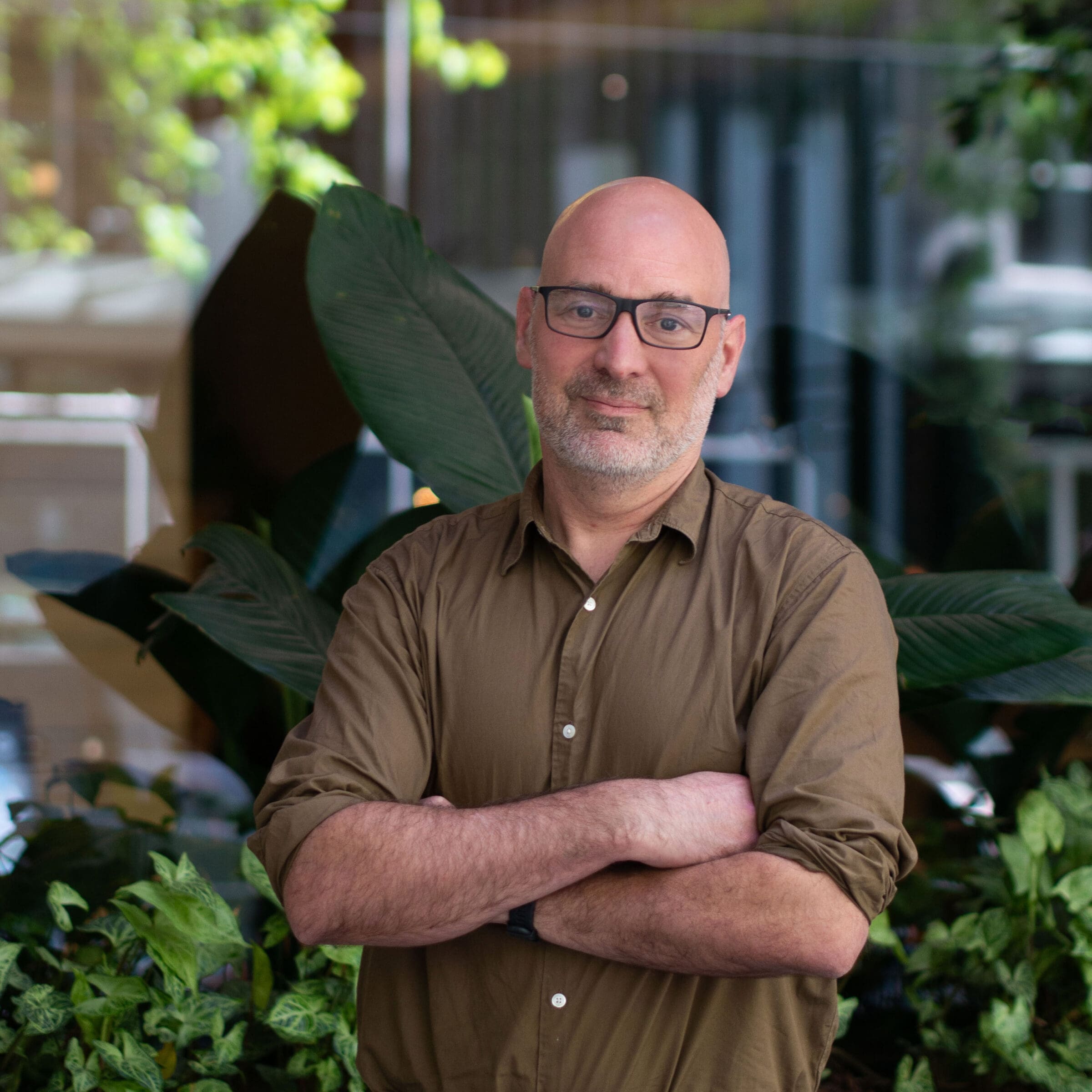
St. Luke’s, Tasmania’s largest health insurer with 100,000 members and a $250 million business, had outgrown its previous accommodation. Staff were spread across four separate, ageing buildings in Launceston’s CBD. Martin says,
Our staff weren’t together. We needed one place where we can all be together.
The solution was not found on a blank slate, but in the bones of something already there. The chosen site, centred on an old auction house with original warehouse components, offered architects the opportunity to regenerate rather than replace. Selected architect Terroir embraced that from the beginning, working to preserve as much of the existing material as possible. The result is a building that carries its history with it. Regenerated, reimagined, and built for the future.

Timber as the Obvious Choice
When St. Luke’s sent its brief to four shortlisted architects, asking each to design a building that reflected a culture of health and a desire for Tasmania to be the healthiest island on the planet, something remarkable happened. Two of the four independently arrived at timber as the defining architectural response. Upon reflection, it was the obvious answer.
Timber offered three converging arguments: it is healthy for the people within it, it functions as a carbon sink for the community, and it sets a blueprint for how buildings should be designed in the future. “It seemed to us very clear that that’s the way we should go,” Martin says.
Terroir’s design was selected as the strongest realisation of that vision, and the project moved forward with timber as its core concept; using cross-laminated timber (CLT) for floors and glue-laminated timber (GLT) for structural elements, with veneer panels used extensively throughout the build to highlight key areas – including black heart sassafras in the foyer, Tas Oak in the stairwells, handrails and other fit out features.

The Goal for All-Tasmanian Timber
From the earliest stages of planning, the ambition was clear: to source all timber from Tasmania. It was the logical extension of the health mission. Tasmanian timber, sustainably grown and locally processed, was the ideal expression of it.
The mission encountered two challenges.
First, the structural mass timber, the CLT required manufacturing capacity that simply did not exist in Tasmania at the time at the required scale, or that could be delivered in the project within the time frame.
The GLT exceeded the island’s capabilities at the time, leading to investment in larger-scale presses and equipment.
The second challenge concerned the floors. St. Luke’s had hoped to finish all levels in Tasmanian timber, working with a local plant producing CLT from Tasmanian plantation hardwood. However, at the time the plant could not produce at the scale or price point the project required.
The dream did not disappear.

Going Global to Build Local
At the time of the St Lukes project, Australian manufacturing capacity was unable to meet the project’s structural timber needs. The team were obligated to looked further afield, landing in Europe. What they found there was humbling in its scale.
“The throughput and the volumes were just phenomenal,” Rees says of the European mass timber facilities. “You could never dream of having something that size in Australia.”
Many of these operations, particularly in Scandinavia and Germany, have been refining their craft for generations, underpinned by cultural traditions around forestry that run deep and a regulatory environment that actively drives timber use. Denmark’s government, for instance, now mandates that all new buildings incorporate a significant timber component of up to 60%. Over time, that kind of policy commitment transforms timber from an alternative into an expectation, founding a natural progression. For Australia, that shift is still to come. But projects like St Lukes are helping to lay the groundwork.
Tasmanian Timber’s Place in the Building
Despite the sourcing challenges, Tasmanian timber found its home in the St. Luke’s Launceston headquarters. The floors occupied by St. Luke’s are finished in Tasmanian plantation hardwood CLT, a deliberate choice to keep the local story alive where it mattered most. The top floor features a decorative ceiling in Tasmanian Oak, its warmth and natural character visible overhead.
The European structural timber, meanwhile, carries its own character. The knotty spruce has prompted something of a reappraisal of aesthetic expectations. In Europe, visible knots are unremarkable, a natural feature of the material. In Australia, they remain unfamiliar. The reaction, however, has been overwhelmingly positive. Martin Says,
I’ve never heard one person talk about the knots negatively. It gives a character; it gives a slight difference. They love it.


The Economic Case for Timber
Timber buildings are often assumed to cost more. The St Lukes project challenges that assumption considerably. The construction timeline was dramatically faster — and speed translates directly into economic benefit, as an earlier building means earlier rental income.
The timber is also a feature. There is no need for suspended ceilings. The acoustic performance of mass timber reduces the soundproofing required, and the natural beauty of the material lowers the investment needed to create an attractive environment for tenants. Rees notes,
Your actual fit-out costs are lower because you use the timber as your feature pieces.
From the tenant side, St. Luke’s is achieving above-market rents. Many tenants are large national and global companies with environmental reporting responsibilities, and a timber building helps them meet those obligations. That willingness to pay a premium flow directly into the value of the asset, ahead of the broader market fully grasping what timber is worth, recognition that St. Luke’s believes is only a matter of time.
The insurance story tells a similar tale. When the project began, Australian insurers were hesitant, assuming timber posed a significant fire risk. St. Luke’s had to make the case that mass timber burns more slowly than steel and concrete before cover could be secured. In the end, insurance was arranged through Europe, and the resulting premium came in lower than an equivalent steel and concrete building would have attracted.

Timber Lessons from the St Luke’s Project
The most significant lesson from the St Lukes project is timing. Supply chain complexity around mass timber in Australia means sourcing decisions must be made far earlier than most project teams expect. Ideally, the conversation about what timber to use and where to source it should begin at the design stage itself, prior to the design being finalised, as this widens options and saves valuable time.
Building a thriving structural timber industry in Tasmania is a long road, and one that will require significant capital investment to develop the manufacturing capacity needed to make Tasmanian plantation hardwood viable for structural use at scale. But the case for making that investment is a compelling one.
Tasmanian timber carries something that cannot easily be replicated elsewhere. Clean energy, sustainably sourced timber, and credible certification. Together, those elements have the makings of a global brand. It will not happen overnight, but the foundations are there.
In the meantime, Tasmania’s decorative timber industry is thriving. Sassafras, Tasmanian Oak, locally grown hardwood plantation material and a host of other local species are finding their way into some of the state’s finest commercial and public spaces, crafted by joiners and tradespeople whose skill is second to none. It is a vivid reminder of what Tasmanian timber is truly capable of.

The Client Makes the Difference
There is one finding from industry research on timber construction that this project reinforces with particular force: the client’s conviction is everything. Where the client champions timber from the outset, as St. Luke’s did, timber finds its way into the building.
Timber is not the future of building; it is the present. The St. Luke’s headquarters has shown what is possible when a client backs timber wholeheartedly. A building that is healthier, faster to construct, cheaper to fit out, and more valuable to its residents. For Tasmania, with world class timber, clean energy, and its craftspeople, the opportunity ahead is extraordinary.
Further Reading: How our homes make us feel has never been more important
Further Reading: Planet Ark’s Make It Wood Campaign joins Tasmanian Timber
To hear the interview with David Rowlinson on Responsibly Sourced Wood, listen to this episode of the Original Thinkers Podcast.