


Kindling: Where Tasmanian Blackwood Meets Molten Glass
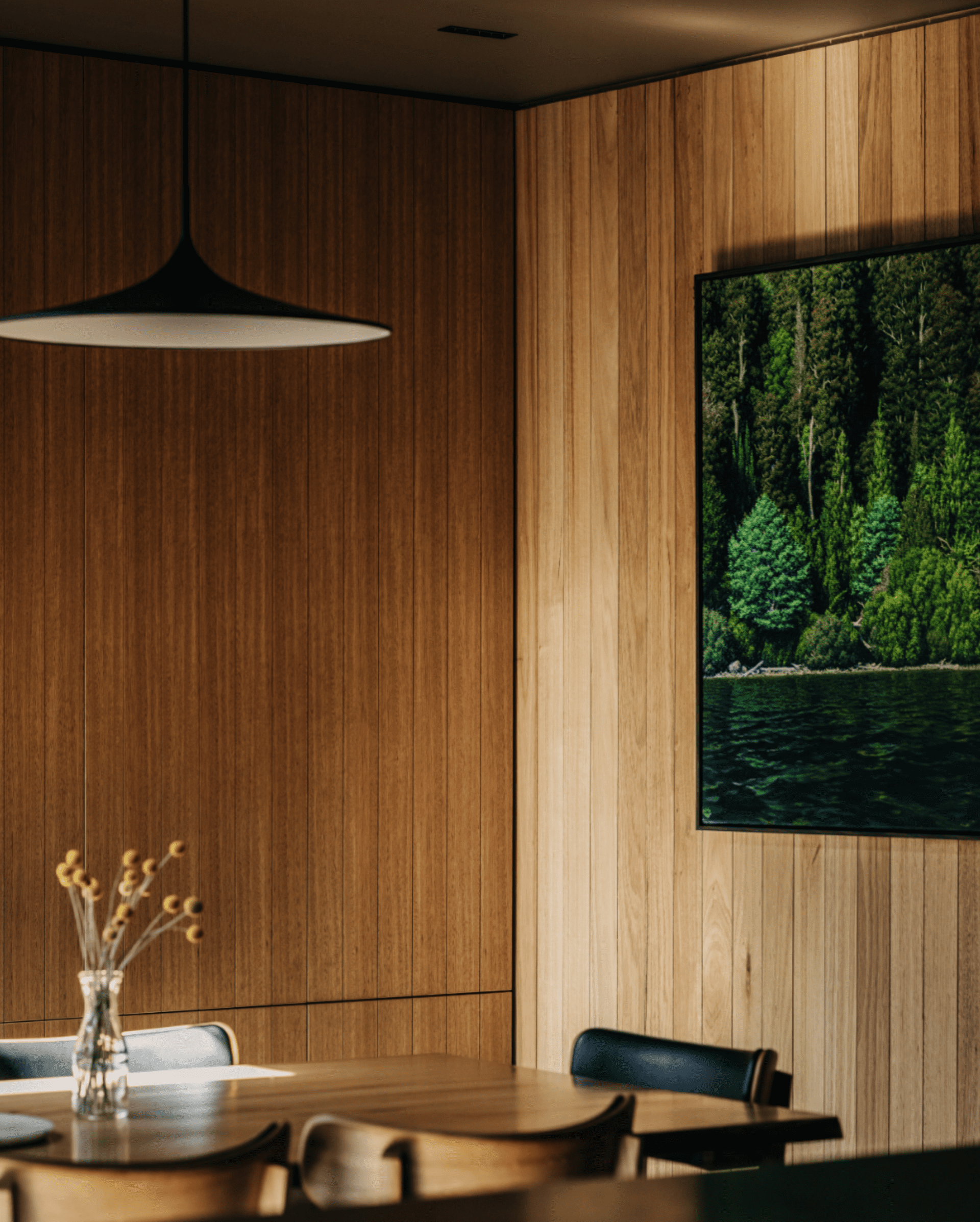
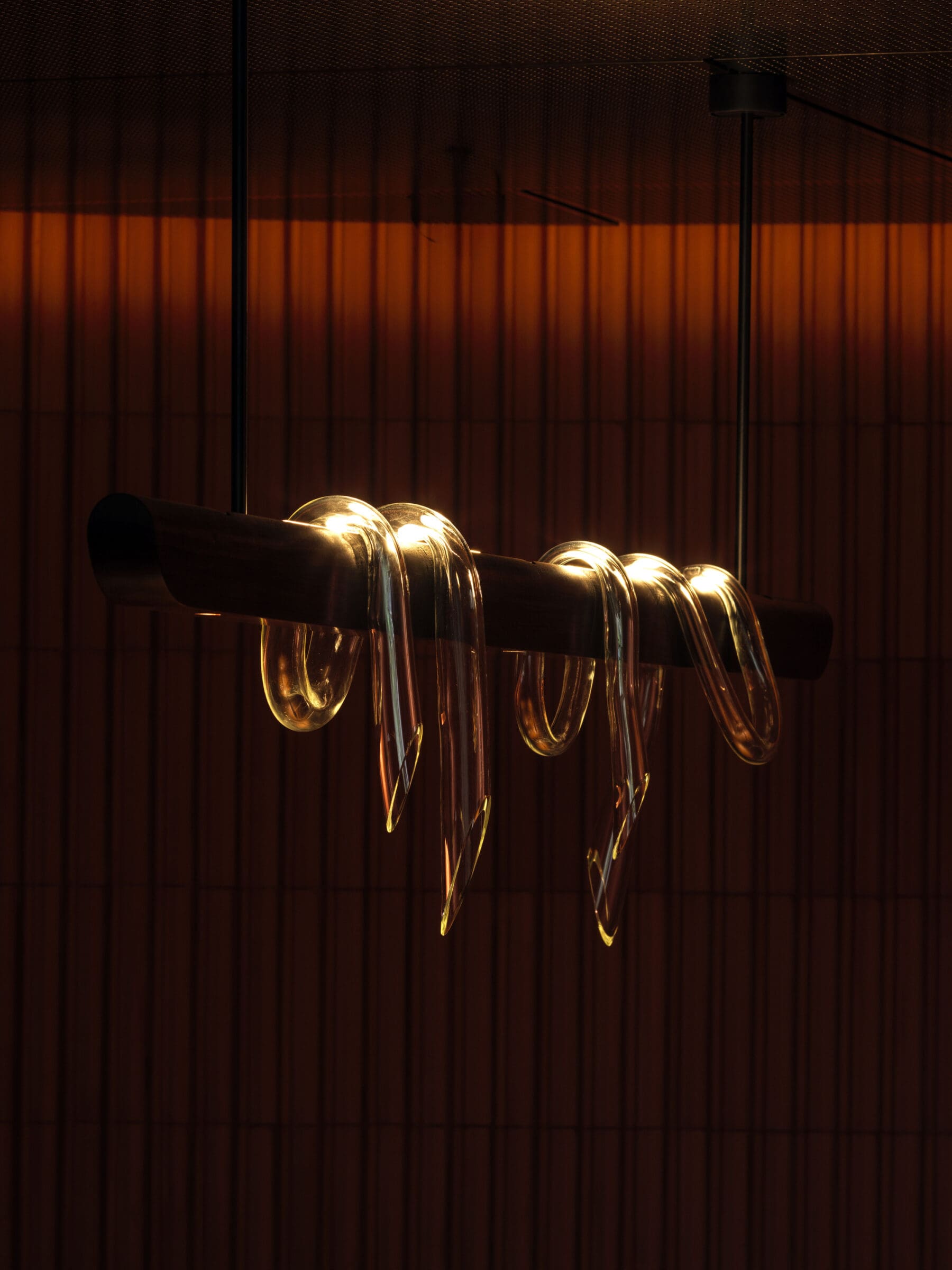
In the private dining room of Yiaga restaurant in Melbourne’s Fitzroy Gardens, a bespoke pendant light overhangs, a design you won’t see anywhere else. Named Kindling, it is the product of an ongoing collaboration between woodworker Adam Markowitz and glassblower Ruth Allen – a meeting of two crafts, pushed to their material limits, unified by one extraordinary Tasmanian timber.
Set Aside for Something Special: The Tasmanian Blackwood Board
The Kindling pendant light was born with a brief set by architect John Wardle of Yiaga. Wardle had made Tasmanian Blackwood a defining material throughout the restaurant design. When Adam and Ruth were engaged to create a key lighting piece for the space, their choice of Tasmanian Blackwood was not accidental – it was a deliberate and considered decision.
Adam Markowitz, whose Melbourne studio is known for furniture and lighting that pushes the limits of material and process, had been saving a particular piece of Tasmanian Blackwood in reserve – the kind of board which is put aside for something special.

“Sometimes when you order timber for a job, some boards are too good to be used for the project they were purchased for,” Markowitz explains. “So, they get set aside for something else. The board for Kindling was like that. It had been sitting on the racks for a while, waiting for the right project.”
The presence of Tasmanian Blackwood was as much about continuity as it was about craft. The same timber flowing through Yiaga’s furniture, joinery and wine cellar, now finding an expressive form overhead.
There are also deeply practical benefits of this material. Molten glass at temperatures approaching and exceeding 1,000 degrees Celsius would be draped directly across the wood, making stability under extreme conditions not simply a preference – but was a requirement.
Given the size and length, it was critical that this remained stable, so I wanted the board to be quartersawn – very hard to find at that scale and length,” says Markowitz. “This board was perfectly quartersawn and even had some figure through it.
Quartersawing is cutting the timber perpendicular to the growth rings. This produces tighter grain and significantly greater dimensional stability than flat-sawn timber board, making it remarkably resistant to temperature change, warping under moisture or in this case, extreme heat.
The Language of Materials: How the Collaboration Begun
The Kindling pendant is the latest and most ambitious iteration of an ongoing collaboration between Adam Markowitz and Ruth Allen. In glassblowing, wooden tools are used to shape molten glass. Over time, where they’ve contacted the glass, they develop a charred and blackened characteristic. Markowitz became fascinated by that contrast – this process was purposely fostered into the design.
“I really enjoyed the contrasting tones and the relationship to the process,” says Markowitz.
Allen, whose Melbourne glass studio in Coburg North has been a site of continuous material experimentation for decades, saw the same potential. Their shared philosophy – that materials are most compelling when encountered in their purest, most elemental form shaped everything about how the Kindling series would be made.
“I find that when materials are at their simplest, that’s when they express the most,” Allen reflects.
The glass was clear. We were just working with a bubble, and then the bubble was squashed with the timber fixture and of course burning. There’s no distraction with colour or fancy elements.
The Kindling series formally launched at Melbourne Design Week 2025. A full-house event at Allen’s studio brought designers, architects and artists together to witness the design and collaborative process live. Now anchored in Yiaga, the collaboration has moved from studio experiment to something with significant impact in the design world.
The Technical Challenges of Kindling
For architects and designers familiar with specifying timber within a predominant understanding of joinery, furniture and interior fit-out – Kindling offers a profound extension of what Tasmanian Blackwood can do and endure. The design process required detailed and technical problem-solving, speaking directly to the qualities that make this species special.
Hugh Allen, owner of Yiaga restaurant, outlined a brief that required the pendant to function not only as a feature light, but as a task light. The light needed to simultaneously illuminate the dining table and food below with LED downlights, while casting the glass elements of the light itself in a glow. LED strip-lights, that travel through the glass elements were used for the latter. The downlight fittings were large, and accommodating these meant Markowitz had to adapt the Blackwood element to be correspondingly thicker, a decision which affected the structure of the whole piece.
Markowitz prepared the timber component thoroughly before it entered the glass studio. Every surface was sanded and completely sealed before burning.

The burning is a very messy process, causing a lot of soot and charcoal, which would have stained the timber through grubby hands,” he explains. “We only wanted it to be charred where the molten glass had touched it – requiring it to be completely sealed prior to coming into the hot shop.
Anticipating the material’s behaviour across different conditions, the makers sequenced the delicate and precise work of the finish and seal of the exposed Blackwood surfaces; until after the burning-glass element.
To enable the glass to be draped and bent around the timber without deforming the tube, Markowitz hand-turned a series of cylindrical formers – with a diameter matching the glass tube. These were screwed into the timber structure as bending aids. Once the glass was draped and had begun to set, these formers had to be rapidly removed.
After we bent the glass, I would come in with a drill like a Formula One pit mechanic and rapidly unscrew these cylinders from the bending armature so the glass could be removed — all while the whole thing was still very much on fire, says Markowitz.
Fire and Form: The Making of the Glass Elements
For Ruth Allen, whose practice spans large-scale commissions and intimate studio work, the Kindling pendant represented a different kind of challenge: one defined not by the complexity of form, but by the physical demands of scale and the unforgiving material of molten glass.

Hot glass moves like liquid – because it is liquid. Its behaviour is controlled by gravity, momentum and temperature. Working it demands an anticipatory intelligence built over decades. Allen describes what she calls “material intelligence”. An understanding so deep that she can set up the glass to move the way she needs it to, while remaining open to adjustments in the moment.
It was all very controlled, but at the same time, you’ve got to be open to the moment,” Allen says. “We need to be agile to what happens in the moment. I’m also trained in that, as well as the team.
The glasswork required a three-person team. Allen allowed for multiple test runs, before committing to finals. The clear glass could be recycled, so the attempts cost energy and time rather than material. But the physical toll was real. At the scale of Kindling, the glass tube becomes extraordinarily heavy at the end of a blowpipe.
It’s very physically demanding for Ruth to be throwing around such a huge weight of glass at the end of a long blowpipe,” Markowitz observes. “At that scale, we didn’t have many opportunities to get it right because it was so extremely physically demanding.
The Char: The Tasmanian Blackwood’s Visible Record
The glass is an incredible aspect of Kindling, but so too is the charring of the Tasmanian Blackwood, which has a fascinating quality. Where the molten glass draped and settled, the timber is deeply charred, the pale golden-brown transformed into a dark, textured surface that speaks of fire and process. The areas untouched by glass retain the timber’s natural warmth and figure.
The contrast between the natural and transformed timber was a concept Markowitz had been deliberately moving towards over years of observation in the glass studio.
I discovered through an earlier collaboration with Ruth how glassblowing tools became charred and blackened where they contacted the glass, but retained their natural colour where they were handled, he explains.
Kindling demonstrates that Tasmanian Blackwood is a timber capable of carrying a story. A design displaying that the material could withstand the thermal shock of repeated glass contact, charring at the surface without fracturing or losing structural integrity, is a reminder that the qualities we admire aesthetically in a fine timber often run far deeper than appearance.

Kindling in Context
Kindling was the last element installed at Yiaga – the final note in a space that had been built beautifully, over years of considered design decision-making. Markowitz describes the moment of installation as both special and slightly nerve wracking.
It was a little bit scary installing once everything was in and looking beautiful, Markowitz said.
Where the dining chairs and tables express Blackwood’s warmth and workability in their most refined state, Kindling expresses something rare. The timber’s capacity to record such an extreme process, becoming more interesting and more unique for having done so.
For architects, designers and specifiers who understand that a great interior is defined not by any single decision, but by the accumulated quality of many. The Kindling light displays what is possible when a species like Tasmanian Blackwood is taken out of its expected context and placed in the hands of makers who understand their craft deeply.