


YIAGA: A RESTURANT CONNECTED TO COUNTRY AND CRAFTMANSHIP
Tucked within the heritage grounds of Fitzroy Gardens in Melbourne, on Wurundjeri Country, Yiaga is a restaurant that knows exactly where it belongs. Shaped by place, season and community, it arrives as one of Australia’s most stunning dining experiences: a space in which every detail, from the food to the furniture, speaks of a deep and genuine connection to this country and its makers.
Chloë Lanser, Associate Principal at architecture and design firm Wardle and Project Director of Yiaga, spoke with Tasmanian Timber about the project, built around craft, community and the inclusion of a remarkable timber, Tasmanian Blackwood.

A brief born from craft
The vision for Yiaga began with a conversation. Hugh Allen, the restaurant’s owner and chef, came to Wardle with a clear and compelling brief: he wanted a distinctly Australian restaurant, one that matched the philosophy of the food being served and the experience he was creating.
“Everything being locally made was the driving force,” Lanser recalls. “The design of the interiors came from conversations between Hugh and John Wardle about craft and craftspeople, and the feel they wanted within the space.”
That conversation became the project’s north star. From the open kitchen to the wine cellar, from the chairs to the pendant lights, every element would be made in Australia, by Australian hands. The restaurant would not merely celebrate local produce on the plate, it would embody it in its very structure.
Terracotta and Tasmanian Blackwood
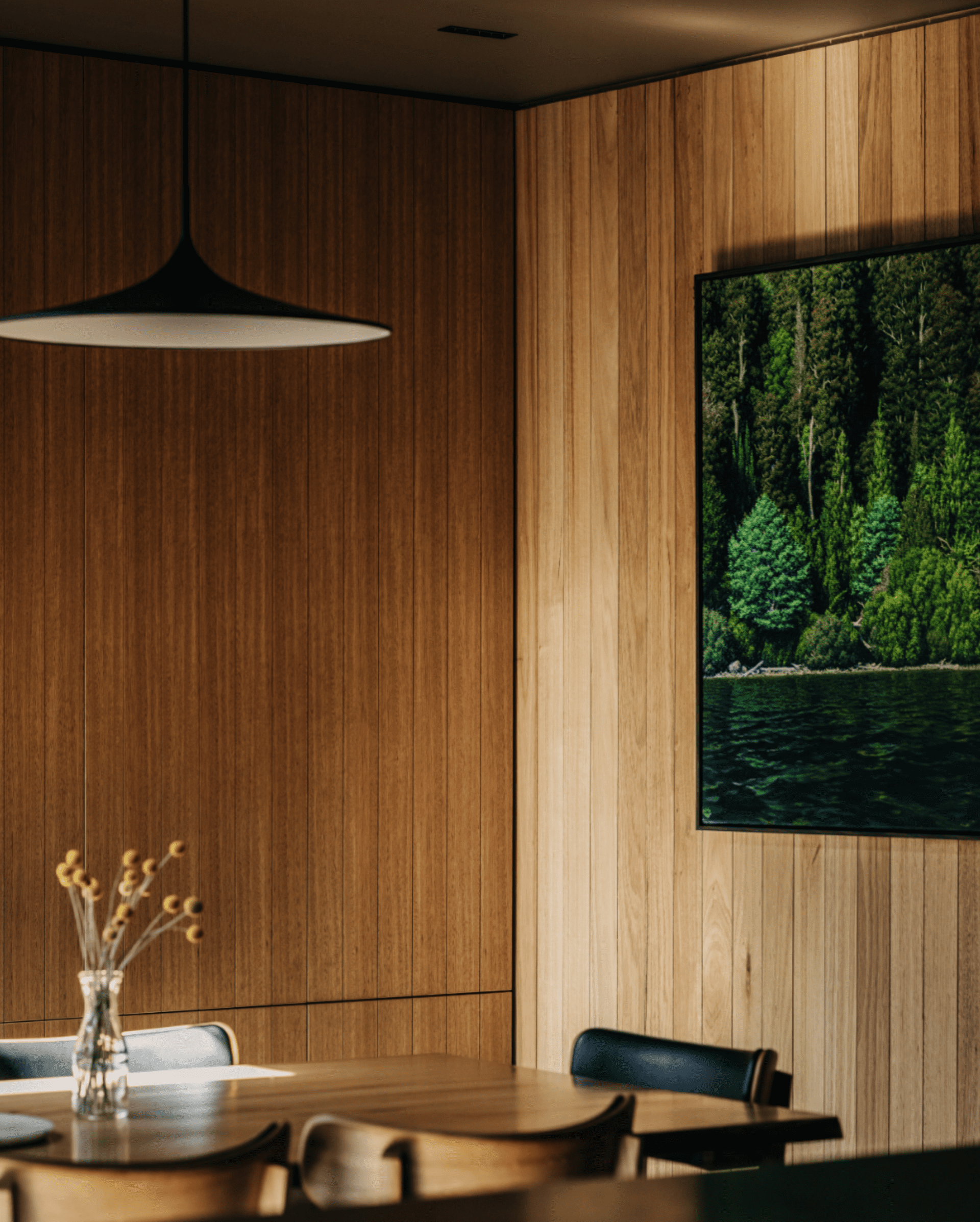
Yiaga’s palette is anchored in the earthy warmth of handmade terracotta tiles, a bold, grounding choice that immediately evokes the Australian landscape. Alongside them, Tasmanian Blackwood was selected as the complementary timber, a pairing that Lanser describes as entirely natural. “The main material is the terracotta tiles,” she explains, “and bringing in a timber to complement the colour and texture brought a beautiful tonality to the space.”
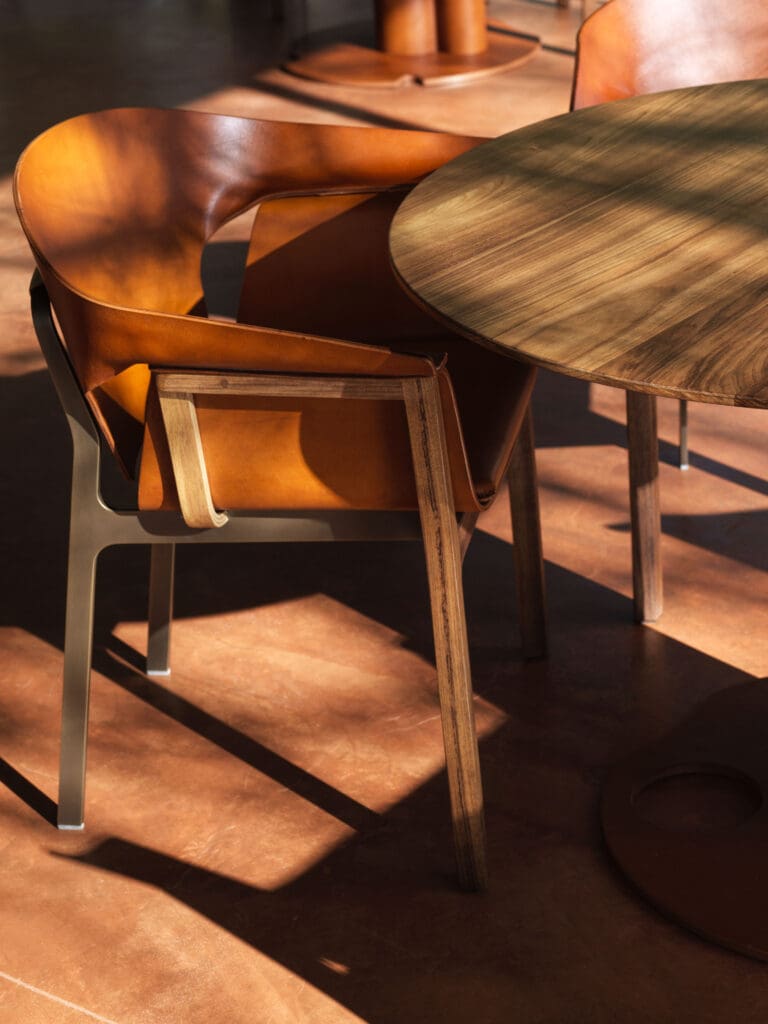

All the timber in the restaurant, from the drinks trolley, tables, chairs and the magnificent wine cellar, is Tasmanian Blackwood. Its warm, golden-brown hue with occasional streaks of darker grain sits in quiet conversation with the terracotta, each material amplifying the other. But it is the quality of softness that Lanser believes is the most important thing Blackwood brought to the space.
“They are all natural materials, but the timber adds softness,” she says. “Particularly where guests interact with it, the tables and chairs, there is a quietness to them.”
It is the kind of detail most diners will never consciously notice, and precisely the kind that shapes an experience. Yiaga is a quiet, polite, beautiful atmosphere, and Tasmanian Blackwood is part of what makes it so.
Why Tasmanian Blackwood?
Celebrated Australian designer maker, Jon Goulder was engaged to make the dining chairs, and from there the timber selection process began in earnest. “It started with Jon and the chair,” says Lanser, “and we worked through several timbers until we had picked the perfect sample.”
When they arrived at Tasmanian Blackwood and moulded leather the choice was confirmed on multiple levels. There was the aesthetic, the tone was simply right for the space. And then there was the origin.
“We liked that it was Tasmanian and locally sourced,” Lanser says. “That it was the perfect colour for the space.”
In a project driven by the idea of local making and Australian identity, where the timber came from mattered as much as how it looked.
The cellar, timber, wine and atmosphere.
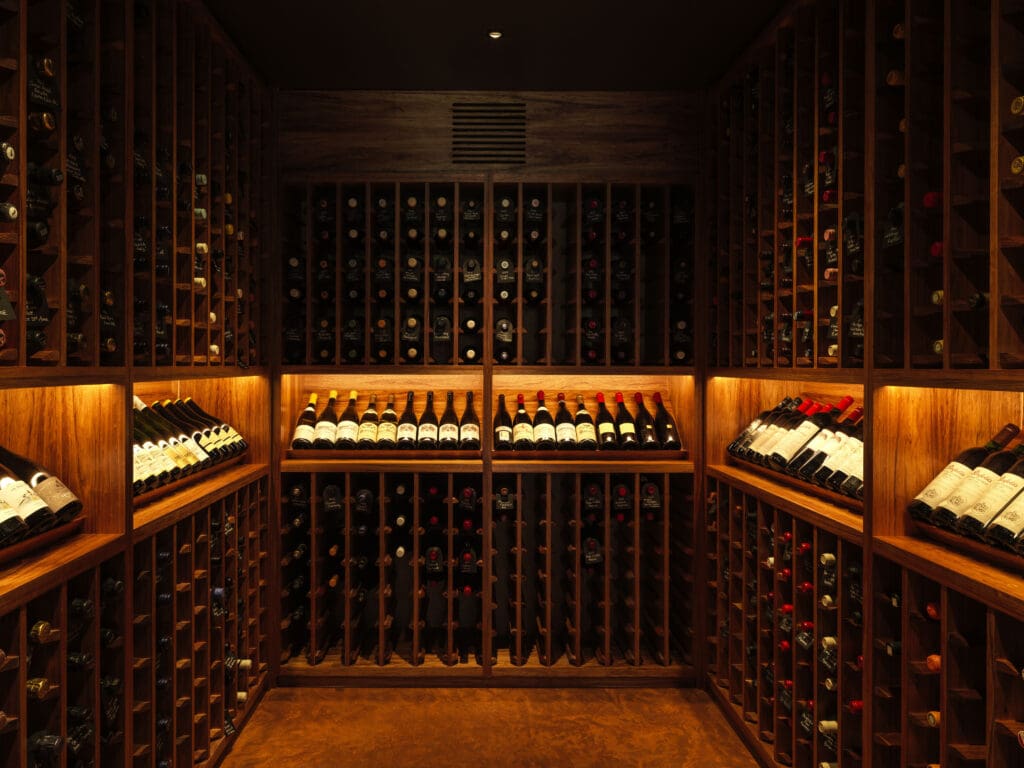
Perhaps nowhere is the Blackwood more immersive than in Yiaga’s wine cellar. Designed by Wardle and brought to life by joiner Ross Thompson, the cellar is a space that engages all the senses.
“Timber lends itself to cellars,” Lanser says simply. “Imagine the smell of timber and wine.”
The cellar is temperature-controlled and enclosed, which means the scent of the Blackwood is always present creating an atmosphere that is as aromatic as it is visual. “The Blackwood, wine and terracotta work together to create a very special atmosphere,” she reflects.
When molten glass meets wood
Among all the objects in Yiaga, one stands apart for its sheer drama and singularity. In the private dining room hangs a pendant light that is unlike almost anything else in contemporary Australian design, a collaboration between Adam Markowitz Design and glassblower Ruth Allen.
The process was as raw as the result. “Adam first made the Blackwood timber component of the light,” Lanser recounts, “then Ruth blew the molten glass and laid it across the timber.”
“It charred into the timber as the glass was soft and alight, burning the Blackwood as it settled in.”

The result is an object that carries within it the memory of its own making, scorched, handmade, irreplaceable. It was the last element to be installed on site, and perhaps appropriately so. Some things are worth saving for last.
Connecting the restaurant and landscape
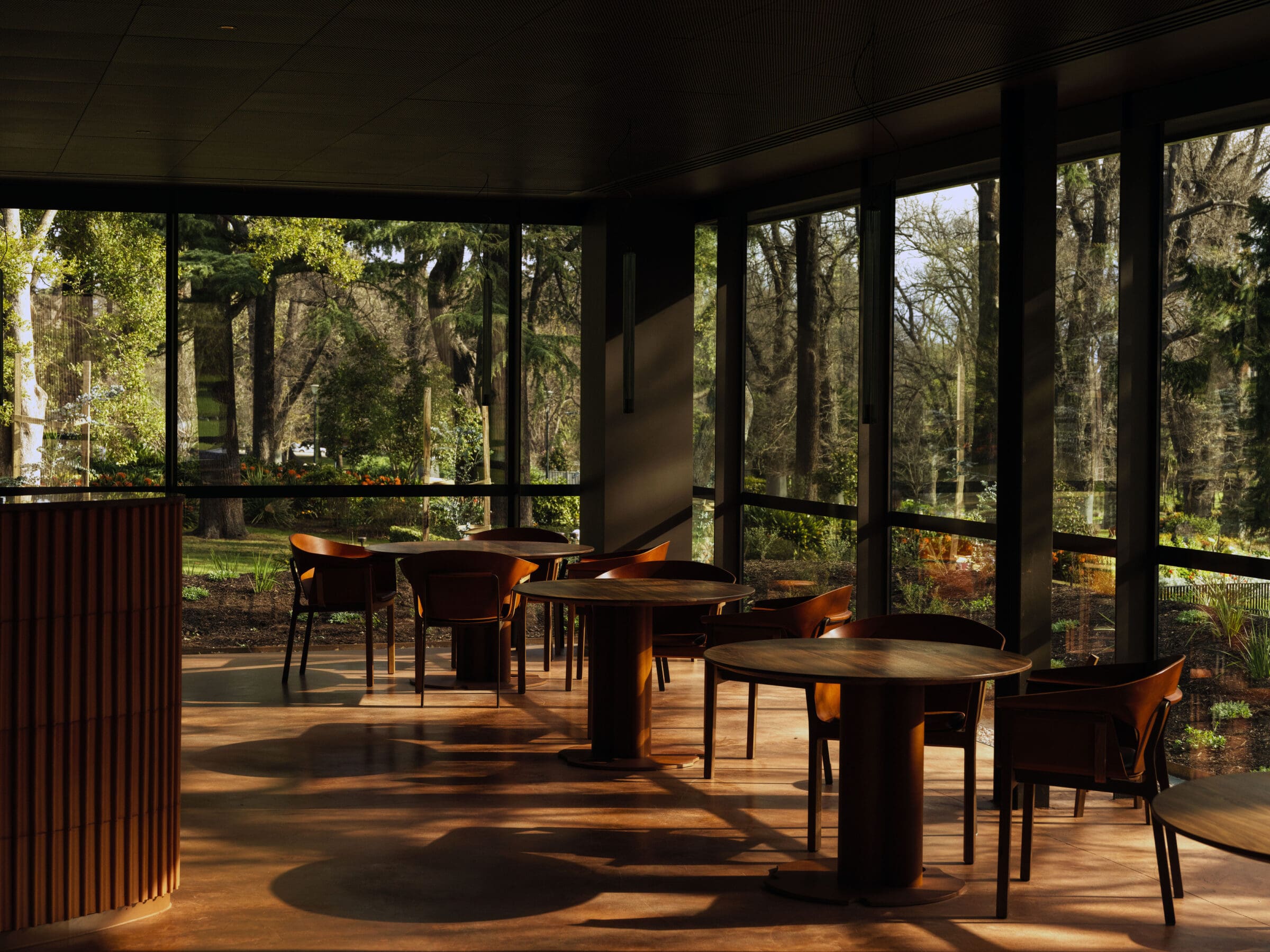
Yiaga exists in a particular relationship with its surroundings. Sitting within Fitzroy Gardens, beneath century-old elm trees, the restaurant belongs to the landscape as much as it belongs to the city. And Tasmanian Blackwood is part of what makes that connection feel real.
“Through the windows you look out over Fitzroy Gardens,” Lanser says, “and the timber connects the restaurant to the native landscaping and the gardens outside. The historic elm trees add to the sense of being in a broader landscape for the lunch settings.”
The experience shifts with the light. At lunch, the gardens flood the restaurant with natural warmth and the sense of dining in a living landscape. By evening, small illuminations in the gardens pick out trees and plantings, and the restaurant turns inward: intimate, glowing and anchored by the deep warmth of terracotta and Blackwood.

A restaurant and a work of art
Lanser was among the first to dine at Yiaga before it opened. “The food is spectacular,” she says. “It has all the touch points, the staff, the team, they are all in tune and professional. The open kitchen means you see that operation, the front of house and the kitchen. It is an experience. Nothing is hidden; it is all on show.”
The kitchen is open. The materials are honest. The provenance of everything, from the food to the furniture, is traceable and true. It is a restaurant shaped, as its founder intended, by place, by season, and by community.
And beneath all of it is a timber from Tasmania, warm, workable, local and stunning.